Letter:
[New York, USA]
(1939)→Letter:
New York, New York, USA
(1939)→Letter:
London, England
(30.11.1939)→Letter:
New York, New York, USA
(06.02.1940)→Letter:
Rotterdam, Netherlands
(02.1940)→Letter:
New York, New York, USA (86th Street Branch)
(20.03.1940)→Letter:
New York, New York, USA
(04.1940)→Letter:
Forest Hills, Long Island, New York, USA
(30.05.1940)→Resided (1940):
Bayreuth
(1940)→Emigrated to:
USA
(1940)→Letter:
München (Munich), Germany
(1940)→Letter:
New York, New York, USA
(04.02.1941)→Letter:
[New York, New York, USA]
(04.02.1941)→Letter:
Bronx, New York, USA
(10.02.1941)→Letter:
Stuttgart, Germany
(04.04.1941)→Letter:
New York
(1941)→Letter:
Munich, Germany
(25.10.1941)→Letter:
Basel, Switzerland
(07.11.1941)→Letter:
New York, New York, USA
(07.11.1941)
Emigration
Date
1940
Destination
USA
Correspondence (24 documents)
+18 more
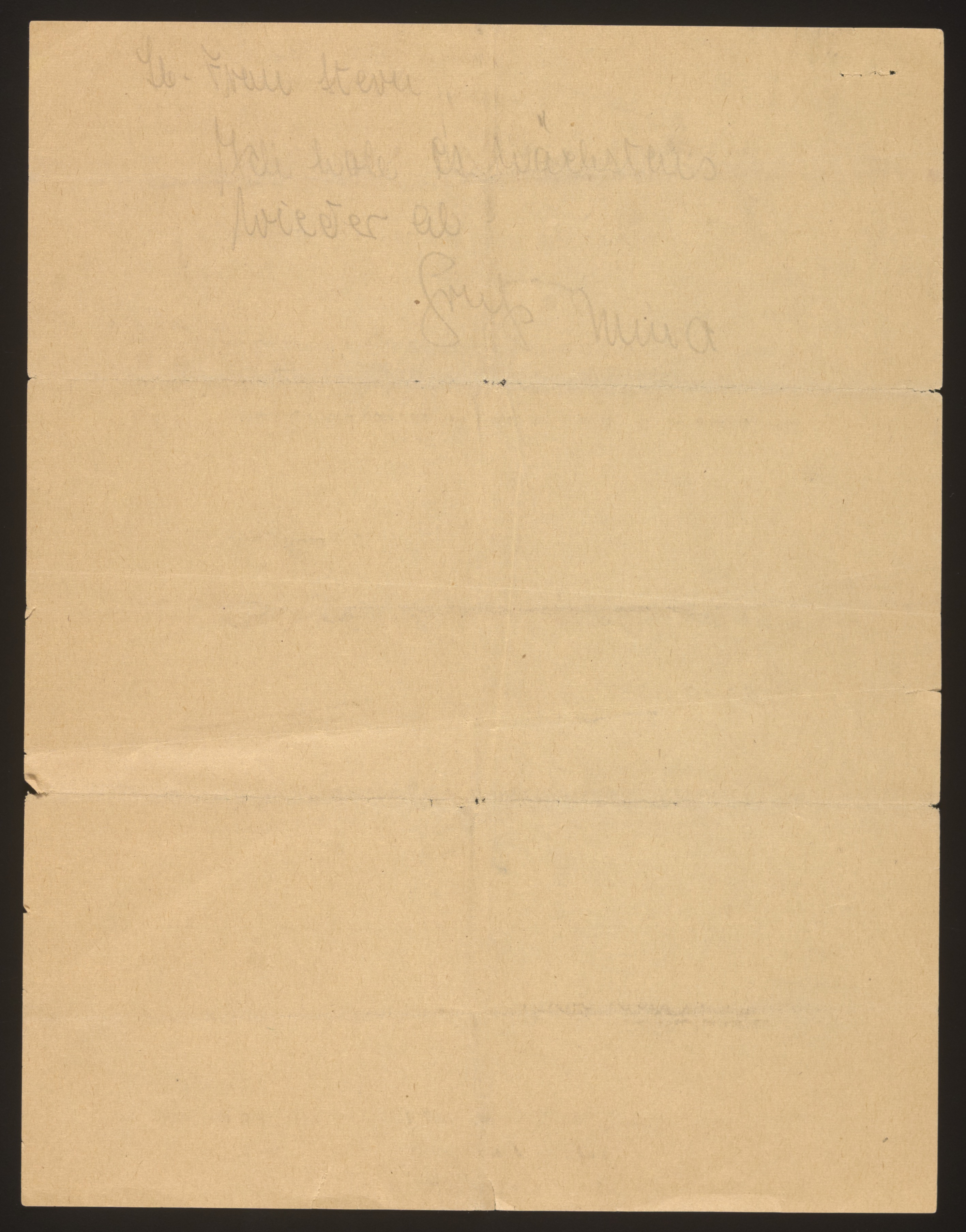
Brief handwritten pencil note from Mina
1939
Transcribed
Dear Mrs. Steve!
Has [the devotional/religious matter?] [returned/come back] again!
Greetings, Mina
Lb. Frau Steve!
Hat sich Andächtiges [?]
wieder ab!
Grüße Mina
This brief, faint pencil note appears to be a quick personal message from Mina Kaufmann to a "Mrs. Steve" — likely a friend or neighbor. The note is largely illegible due to the light pencil writing and age of the document. It was preserved among the Oppenheimer immigration papers, suggesting it was jotted on the back of one of the documents being assembled for the visa application. The casual, abbreviated tone contrasts with the formal legal documents surrounding it, offering a glimpse of the everyday social interactions that continued alongside the urgent immigration work.
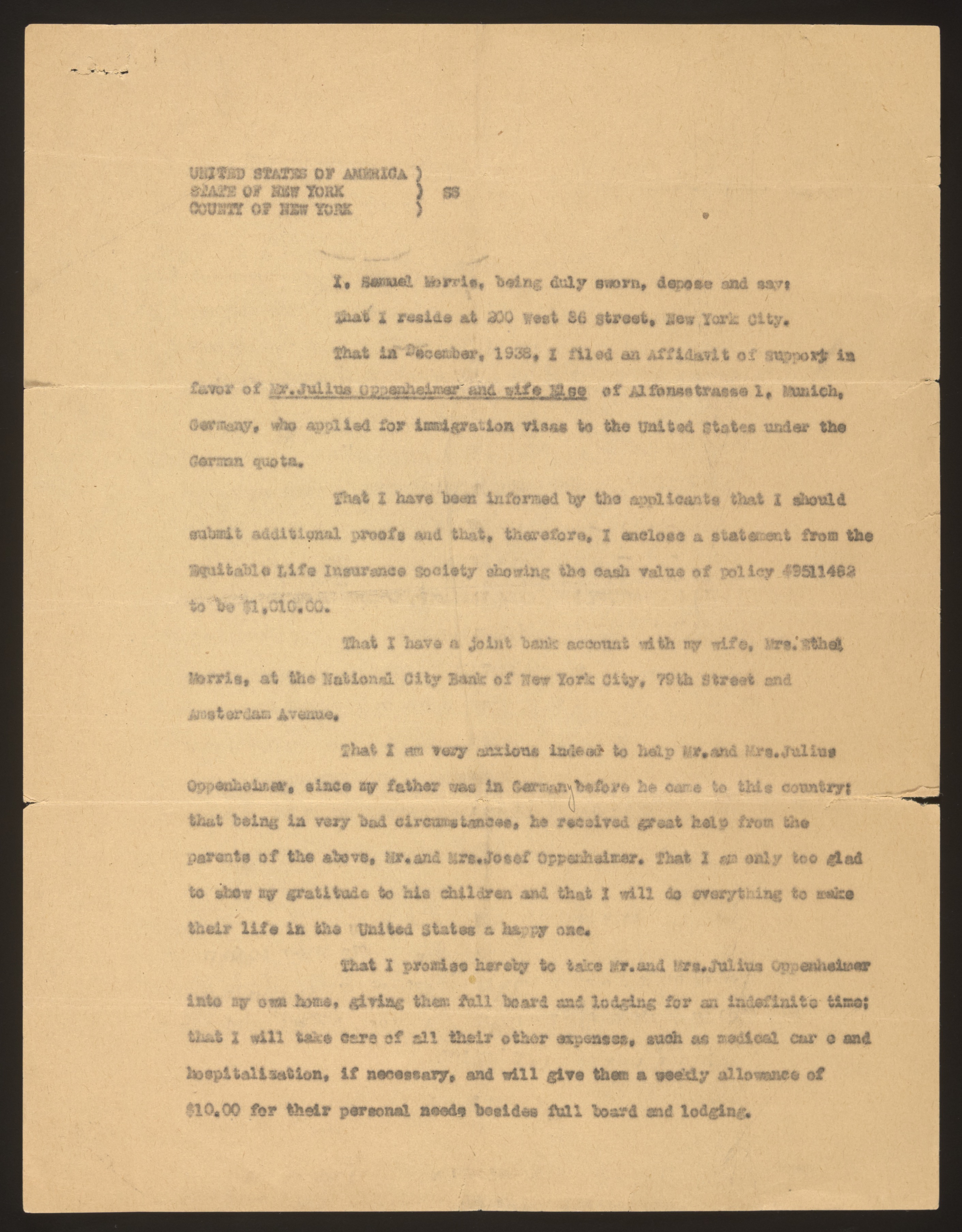
Typed updated affidavit of support from Samuel Morris (page 1 of 2)
1939
Transcribed
None
UNITED STATES OF AMERICA }
STATE OF NEW YORK } SS
COUNTY OF NEW YORK }
I, Samuel Morris, being duly sworn, depose and say:
That I reside at 200 West 86 Street, New York City.
That in December, 1938, I filed an affidavit of support in
favor of Mr. Julius Oppenheimer and wife Mrs. of Alfonsstrasse 1, Munich,
Germany, who applied for immigration visas to the United States under the
German quota.
That I have been informed by the applicants that I should
submit additional proofs and that, therefore, I enclose a statement from the
Equitable Life Insurance Society showing the cash value of policy #551462
to be $1,016.00.
That I have a joint bank account with my wife, Mrs. Ethel
Morris, at the National City Bank of New York City, 79th Street and
Amsterdam Avenue.
That I am very anxious indeed to help Mr. and Mrs. Julius
Oppenheimer, since my father was in Germany before he came to this country;
that being in very bad circumstances, he received great help from the
parents of the above, Mr. and Mrs. Josef Oppenheimer. That I am only too glad
to show my gratitude to his children and that I will do everything to make
their life in the United States a happy one.
That I promise hereby to take Mr. and Mrs. Julius Oppenheimer
into my own home, giving them full board and lodging for an indefinite time;
that I will take care of all their other expenses, such as medical care and
hospitalization, if necessary, and will give them a weekly allowance of
$10.00 for their personal needs besides full board and lodging.
This updated affidavit from Samuel Morris expands significantly on his earlier letters (0003/0005) and provides crucial genealogical information. Morris reveals that his father had been helped by "Mr. and Mrs. Josef Oppenheimer" — Julius's parents — when the elder Morris was in dire circumstances in Germany. This confirms that the Oppenheimer family's reputation for generosity extended back at least one generation, to Josef Oppenheimer (Julius's father, b. ~1860s in Gemmingen). Morris's gratitude is deeply personal and intergenerational: the Oppenheimers helped his father, and now he wishes to repay that debt by rescuing their son and daughter-in-law. His financial documentation includes an Equitable Life Insurance policy (#551462) worth $1,016 and a joint bank account with his wife Ethel Morris at the National City Bank (79th and Amsterdam — the same bank branch used by Mina Kaufmann in 0011). His promise of full board, lodging, medical care, hospitalization, and $10/week ($215/week today) represents the most comprehensive support package offered by any sponsor.
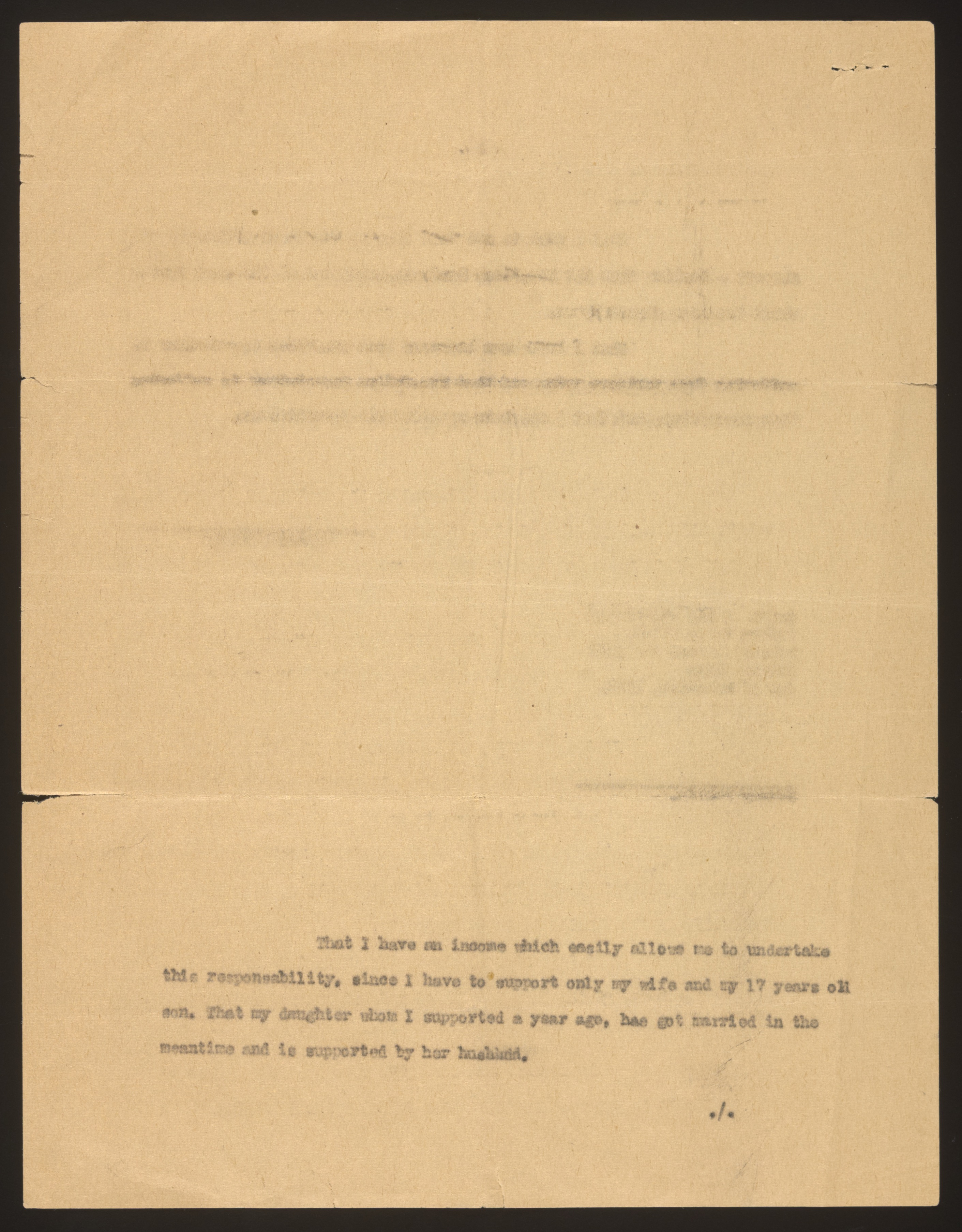
Typed updated affidavit of support from Samuel Morris (page 2 of 2)
1939
Transcribed
None
[Most of page blank — text from page 1 visible as bleed-through]
That I have an income which easily allows me to undertake
this responsibility, since I have to support only my wife and my 17 years old
son. That my daughter whom I supported a year ago, has got married in the
meantime and is supported by her husband.
./.
The conclusion of Samuel Morris's updated affidavit adds personal biographical detail: he supports only his wife and 17-year-old son, and his daughter has recently married and is now supported by her husband — reducing his financial obligations and strengthening his ability to sponsor the Oppenheimers. The "./" notation at the bottom indicates the document continues (likely with a notary page or additional enclosures that were filed separately). Morris's address at 200 West 86th Street — in the same block as Mina Kaufmann at 145 West 86th Street — reinforces the tight geographic cluster of the rescue network on the Upper West Side.
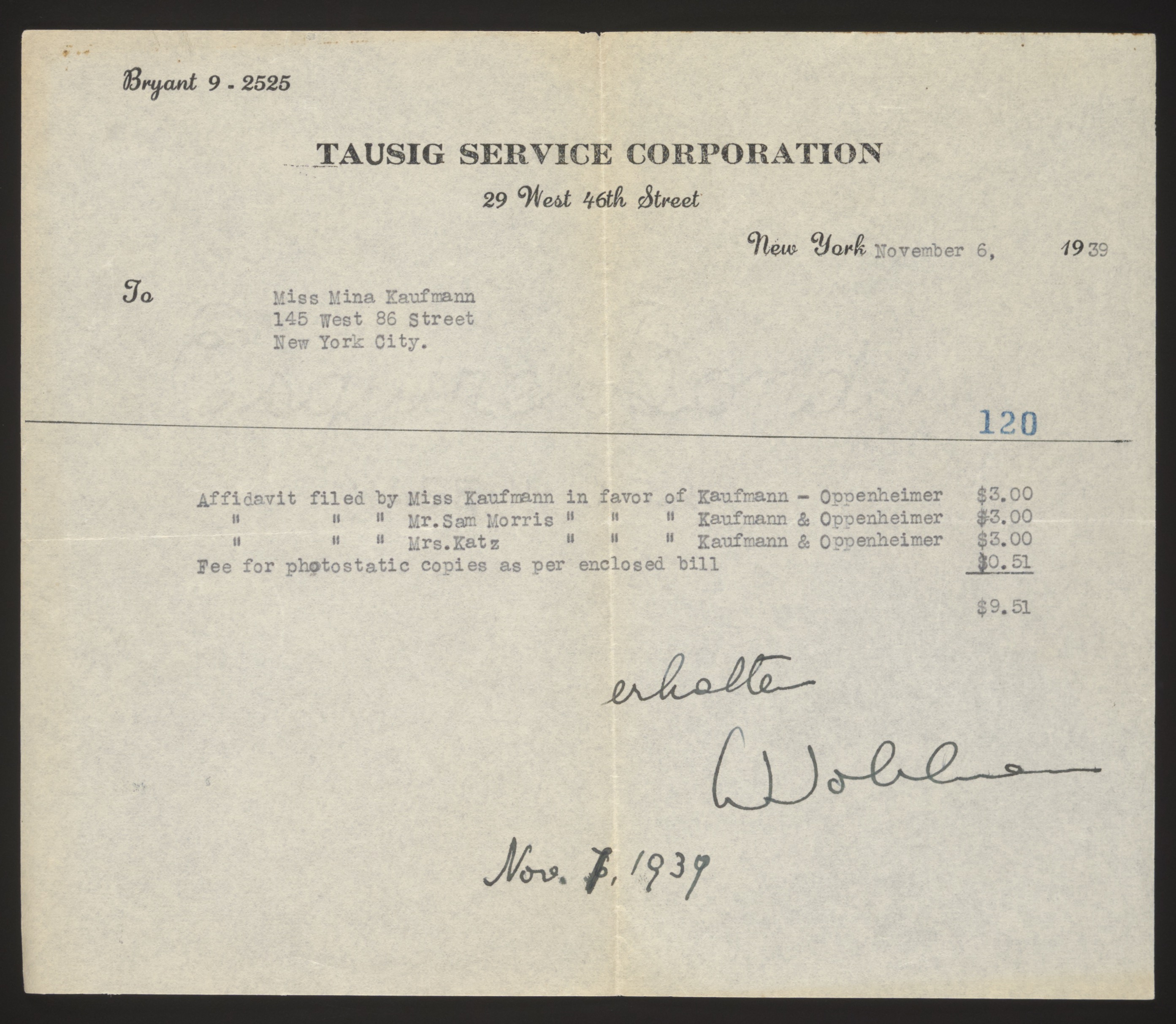
Invoice from Tausig Service Corporation for affidavit filing fees
06.11.1939
Transcribed
This is an invoice from the Tausig Service Corporation, a service agency at 29 West 46th Street, New York, billing Miss Mina Kaufmann at 145 West 86th Street, New York City, for the filing of three affidavits of support in favor of the Kaufmann-Oppenheimer family. The affidavits were filed by Mina Kaufmann, Samuel Morris, and Mrs. Ketz, each costing $3.00. An additional $0.51 was charged for photostatic copies, for a total of $9.51. A handwritten notation "erhalten" (German for "received") with a signature and the date November 7, 1939 confirms payment.
Bryant 9-2525
TAUSIG SERVICE CORPORATION
29 West 46th Street
New York November 6, 1939
To Miss Mina Kaufmann
145 West 86 Street
New York City.
120
Affidavit filed by Miss Kaufmann in favor of Kaufmann – Oppenheimer $3.00
" " " Mr. Sam Morris " " Kaufmann & Oppenheimer $3.00
" " " Mrs. Ketz " " Kaufmann & Oppenheimer $3.00
Fee for photostatic copies as per enclosed bill $0.51
-----
$9.51
erhalten [received]
[Signature: Wohl…]
Nov. 7, 1939
This invoice documents the immigration sponsorship efforts on behalf of Julius and Elsa Oppenheimer. In 1939, Jewish refugees fleeing Nazi Germany needed American sponsors to file affidavits of support — sworn statements guaranteeing financial responsibility — in order to obtain immigration visas. Mina Kaufmann (née Weiler), a cousin already in New York, coordinated multiple affidavits through the Tausig Service Corporation, a firm that assisted refugees with immigration paperwork. Three separate sponsors — Mina herself, Samuel Morris, and a Mrs. Ketz — each filed affidavits. The total cost of $9.51 (approximately $200 in today's money) underscores the bureaucratic expenses involved in the emigration process. The German notation "erhalten" on an American business invoice reflects the bilingual world of German-Jewish refugees in New York.
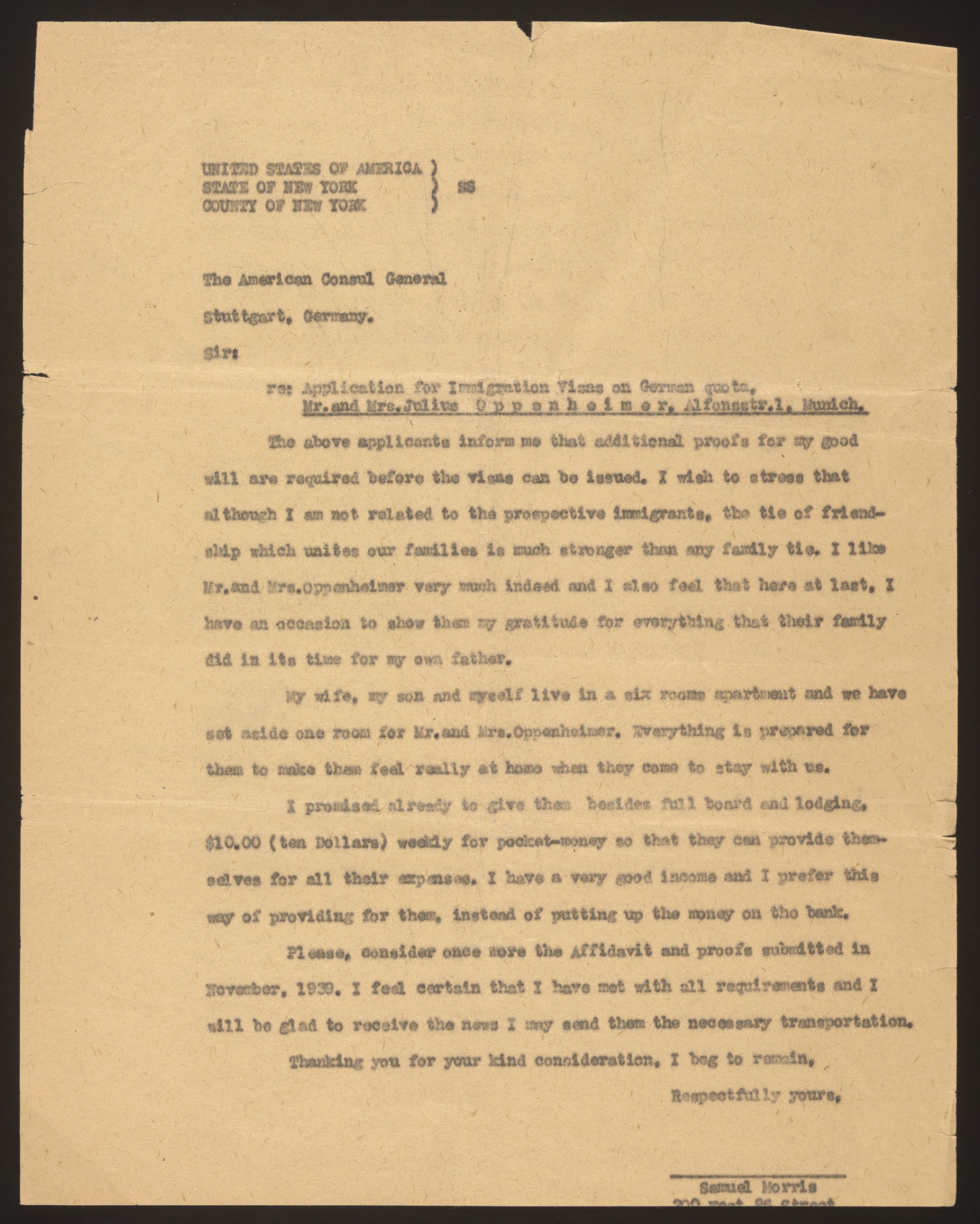
Typed letter / affidavit of support from Samuel Morris to the American Consul...
11.1939
Transcribed
None
UNITED STATES OF AMERICA }
STATE OF NEW YORK } SS
COUNTY OF NEW YORK }
The American Consul General
Stuttgart, Germany.
Sir:
re: Application for Immigration Visas on German quota,
Mr. and Mrs. Julius Oppenheimer, Alfonsstr.1, Munich.
The above applicants inform me that additional proofs for my good
will are required before the visas can be issued. I wish to stress that
although I am not related to the prospective immigrants, the tie of friend-
ship which unites our families is much stronger than any family tie. I like
Mr. and Mrs. Oppenheimer very much indeed and I also feel that here at last, I
have an occasion to show them my gratitude for everything that their family
did in its time for my own father.
My wife, my son and myself live in a six rooms apartment and we have
set aside one room for Mr. and Mrs. Oppenheimer. Everything is prepared for
them to make them feel really at home when they come to stay with us.
I promised already to give them besides full board and lodging,
$10.00 (ten Dollars) weekly for pocket-money so that they can provide them-
selves for all their expenses. I have a very good income and I prefer this
way of providing for them, instead of putting up the money on the bank.
Please, consider once more the Affidavit and proofs submitted in
November, 1939. I feel certain that I have met with all requirements and I
will be glad to receive the news I may send them the necessary transportation.
Thanking you for your kind consideration, I beg to remain,
Respectfully yours,
Samuel Morris
200 West 86 Street [partially visible]
This is a powerful letter from Samuel Morris, a New York resident, to the American Consul General in Stuttgart, supplementing his affidavit of support for Julius and Elsa Oppenheimer's immigration visa application. Morris emphasizes that while not a blood relative, the bond between the families is "much stronger than any family tie" — the Oppenheimer family had helped his own father in the past, and he now wishes to repay that debt. He details concrete plans: a room set aside in his six-room apartment, full board and lodging, and $10 per week in pocket money (about $215/week today). His address at 200 West 86th Street places him in the same Upper West Side neighborhood as Mina Kaufmann (145 West 86th Street), suggesting a close-knit community of German-Jewish immigrants coordinating rescue efforts. The Oppenheimers were living at Alfonsstrasse 1, Munich, at the time of this application. The letter's urgent, personal tone — and its reference to proofs "submitted in November, 1939" — reflects the increasingly desperate race against time as war had already broken out in Europe.
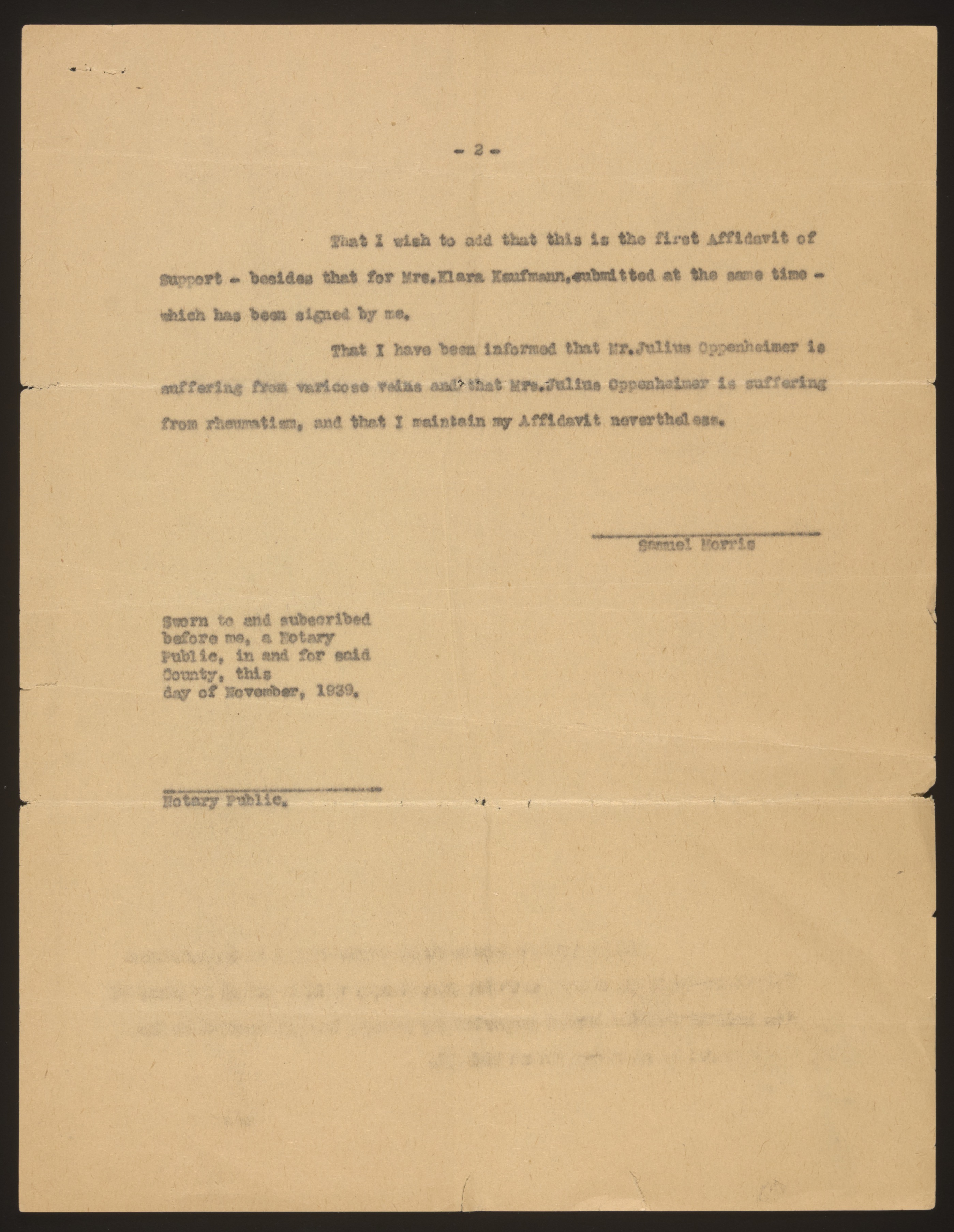
Typed affidavit of support from Samuel Morris (page 2 of 2), with notary jurat
11.1939
Transcribed
None
- 2 -
That I wish to add that this is the first Affidavit of
support — besides that for Mrs. Klara Kaufmann, submitted at the same time —
which has been signed by me.
That I have been informed that Mr. Julius Oppenheimer is
suffering from varicose veins and that Mrs. Julius Oppenheimer is suffering
from rheumatism, and that I maintain my Affidavit nevertheless.
________________________
Samuel Morris
Sworn to and subscribed
before me, a Notary
Public, in and for said
County, this
day of November, 1939.
________________________
Notary Public.
This second page of Samuel Morris's affidavit contains two significant statements. First, he declares that this is his first affidavit of support (apart from one simultaneously filed for Mrs. Klara Kaufmann), addressing the consulate's concern about sponsors overextending themselves with multiple guarantees. Second, and more poignantly, he acknowledges being informed of the Oppenheimers' health conditions — Julius suffering from varicose veins and Elsa from rheumatism — and explicitly states he maintains his sponsorship "nevertheless." This was a critical declaration: U.S. consulates routinely denied visas to immigrants with health conditions, fearing they would become public charges. By acknowledging the conditions and reaffirming his commitment, Morris was directly countering a common ground for visa refusal. The mention of Klara Kaufmann receiving a parallel affidavit connects to the broader family rescue network visible across this correspondence folder.
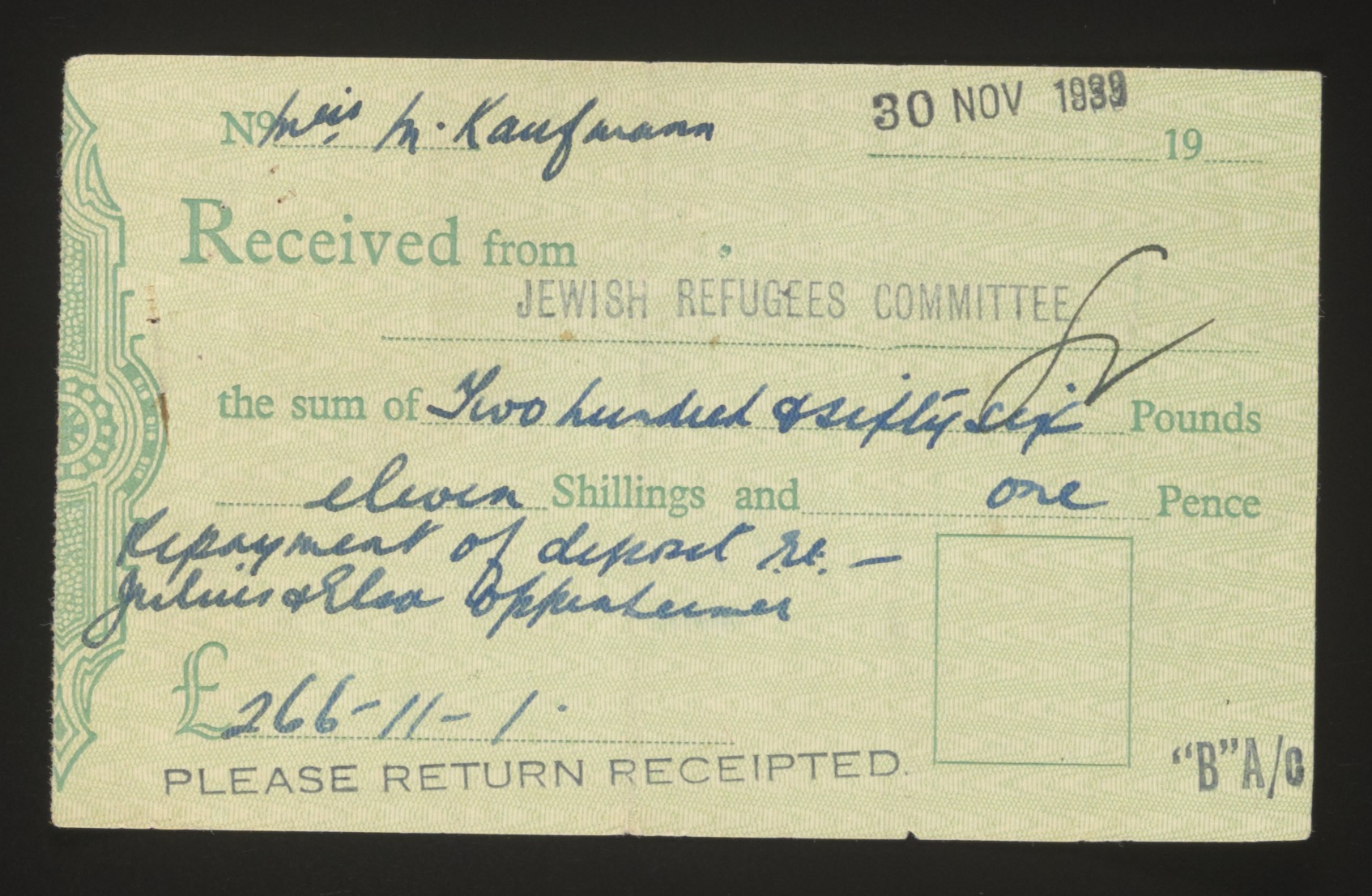
Receipt from the Jewish Refugees Committee for repayment of deposit
30.11.1939
Transcribed
This is a printed receipt form issued to M. Kaufmann, documenting a payment received from the Jewish Refugees Committee in the amount of £266, 11 shillings, and 1 penny. The payment is described as "Repayment of deposit re: Julius & Elsa Oppenheimer." The receipt is dated November 30, 1939, and marked as "B" account.
No. [illegible] M. Kaufmann 30 NOV 1939 19
Received from
JEWISH REFUGEES COMMITTEE
the sum of Two hundred & sixty six Pounds
eleven Shillings and one Pence
Repayment of deposit re: —
Julius & Elsa Oppenheimer
£266-11-1.
PLEASE RETURN RECEIPTED. "B" A/c
This receipt reveals that Julius and Elsa Oppenheimer's emigration from Nazi Germany involved transit through England, facilitated by the Jewish Refugees Committee — a British organization that assisted Jewish refugees. The substantial sum of £266/11/1 (equivalent to roughly £18,000–£20,000 today) was a deposit or bond required by the British government as a guarantee that refugees would not become a public charge. The repayment to M. Kaufmann (likely Mina Kaufmann, the family's American cousin and principal sponsor) suggests that the deposit was returned after Julius and Elsa either departed England for their final destination or met other conditions. This document connects to the parallel American affidavit process documented in 0001, showing the two-track emigration effort — British transit permits and American immigration visas — being coordinated simultaneously in late 1939.
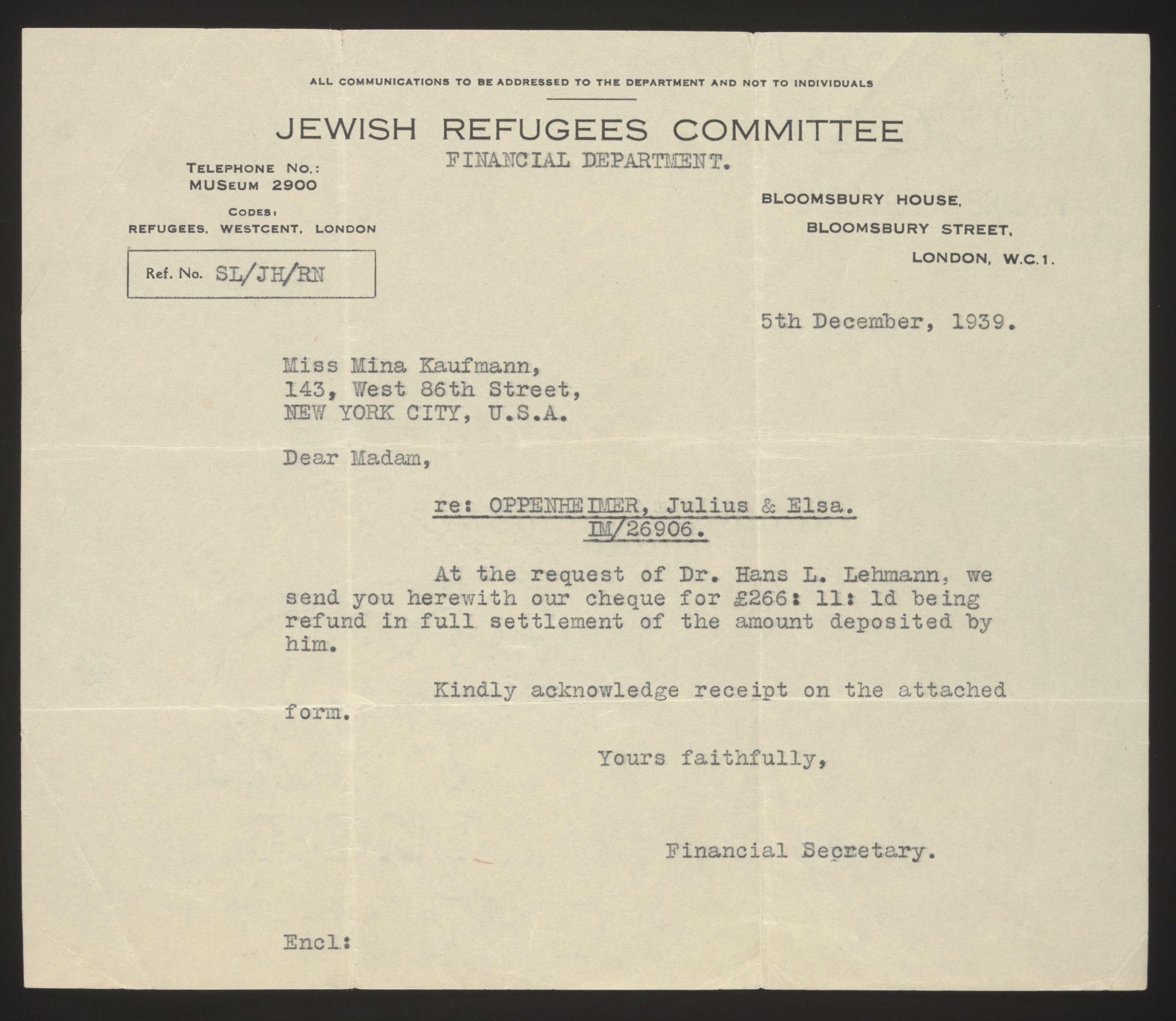
Typed letter from the Jewish Refugees Committee (Financial Department) to Min...
05.12.1939
Transcribed
None
ALL COMMUNICATIONS TO BE ADDRESSED TO THE DEPARTMENT AND NOT TO INDIVIDUALS
JEWISH REFUGEES COMMITTEE
FINANCIAL DEPARTMENT.
TELEPHONE No.: BLOOMSBURY HOUSE,
MUSEUM 2900 BLOOMSBURY STREET,
LONDON, W.C.1.
CODES:
REFUGEES, WESTCENT, LONDON
Ref. No. SL/JH/RN 5th December, 1939.
Miss Mina Kaufmann,
143, West 86th Street,
NEW YORK CITY, U.S.A.
Dear Madam,
re: OPPENHEIMER, Julius & Elsa.
M/26906.
At the request of Dr. Hans L. Lehmann, we
send you herewith our cheque for £266: 11: 1d being
refund in full settlement of the amount deposited by
him.
Kindly acknowledge receipt on the attached
form.
Yours faithfully,
Financial Secretary.
Encl:
This letter from the Jewish Refugees Committee at Bloomsbury House, London — the central hub for Jewish refugee assistance in Britain — confirms the refund of £266/11/1 previously deposited on behalf of Julius and Elsa Oppenheimer (case number M/26906). The refund was requested by Dr. Hans L. Lehmann, who had originally deposited the funds as a financial guarantee for the Oppenheimers' stay in England. The cheque was sent to Mina Kaufmann in New York, connecting the London and New York branches of the family's rescue network. This letter is the companion document to the receipt in 0002, which records the same amount. Bloomsbury House at Bloomsbury Street, WC1, served as the headquarters for multiple Jewish refugee organizations during the war years, coordinating transit, sponsorship, and resettlement for thousands of refugees. The reference number M/26906 and Dr. Lehmann's involvement suggest a structured process through which guarantors could reclaim deposits once refugees had moved on from Britain.
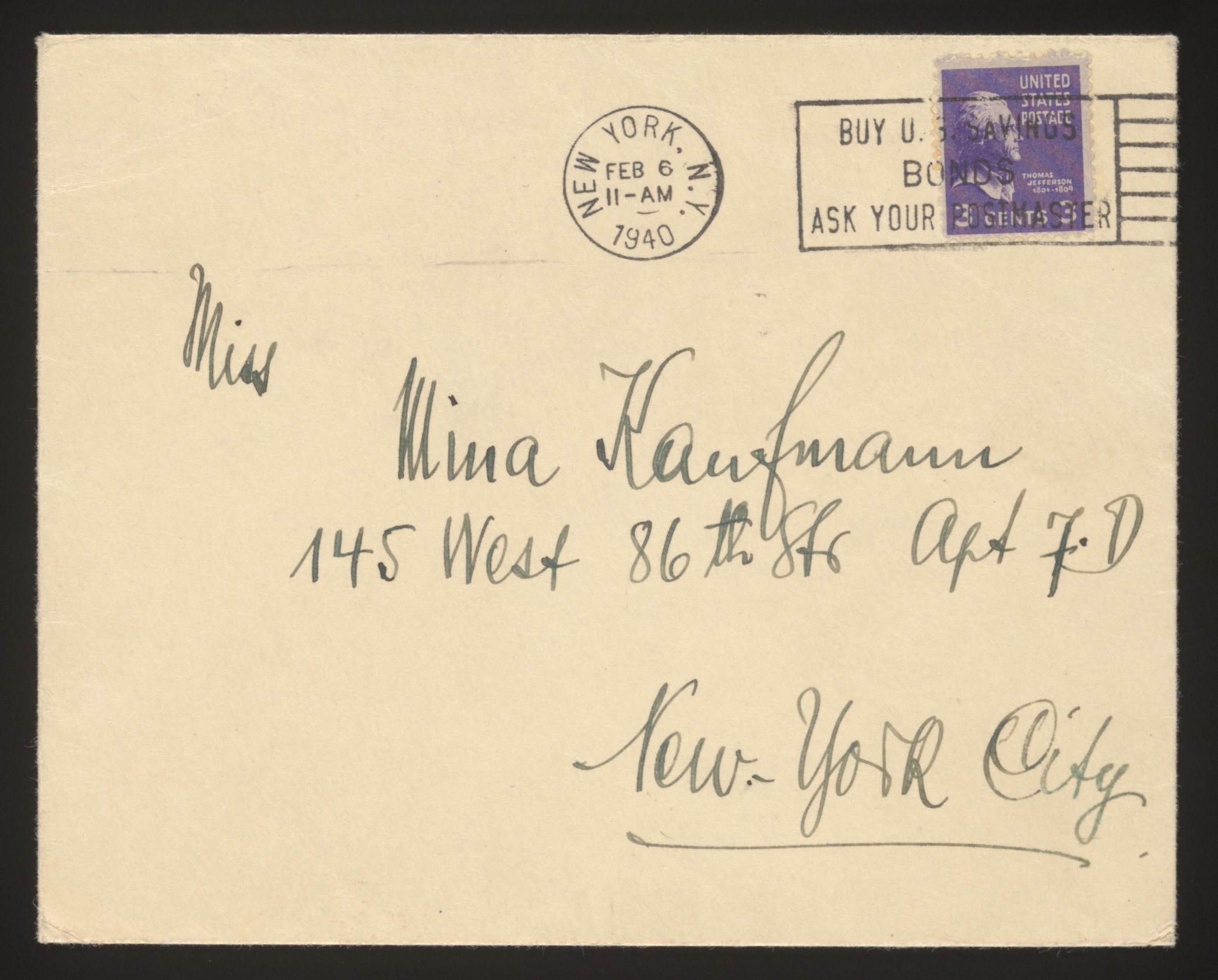
Envelope front addressed to Mina Kaufmann, posted from New York
06.02.1940
Transcribed
None
[Postmark circle:] NEW YORK, N.Y. / FEB 6 / 11-AM / 1940
[Machine slogan cancel:] BUY U.S. SAVINGS BONDS / ASK YOUR [postal clerk?]
[3-cent Thomas Jefferson stamp, purple]
Miss
Mina Kaufmann
145 West 86th Str. Apt 7. D
New-York City.
This envelope was addressed to Mina Kaufmann at her apartment at 145 West 86th Street, Apt. 7D, New York City. Despite the New York postmark of February 6, 1940, the return address on the reverse (0010) identifies the sender as Arthur Baer of Rotterdam, Netherlands. The letter was likely forwarded or re-mailed within New York after arriving from Europe. The machine cancel promoting U.S. Savings Bonds was a standard postal slogan of the period. Arthur Baer's involvement from Rotterdam connects to the broader network of European contacts assisting with the Oppenheimer emigration — Rotterdam was a major port of departure for transatlantic crossings, and Baer may have been involved in arranging the Oppenheimers' transit through the Netherlands.
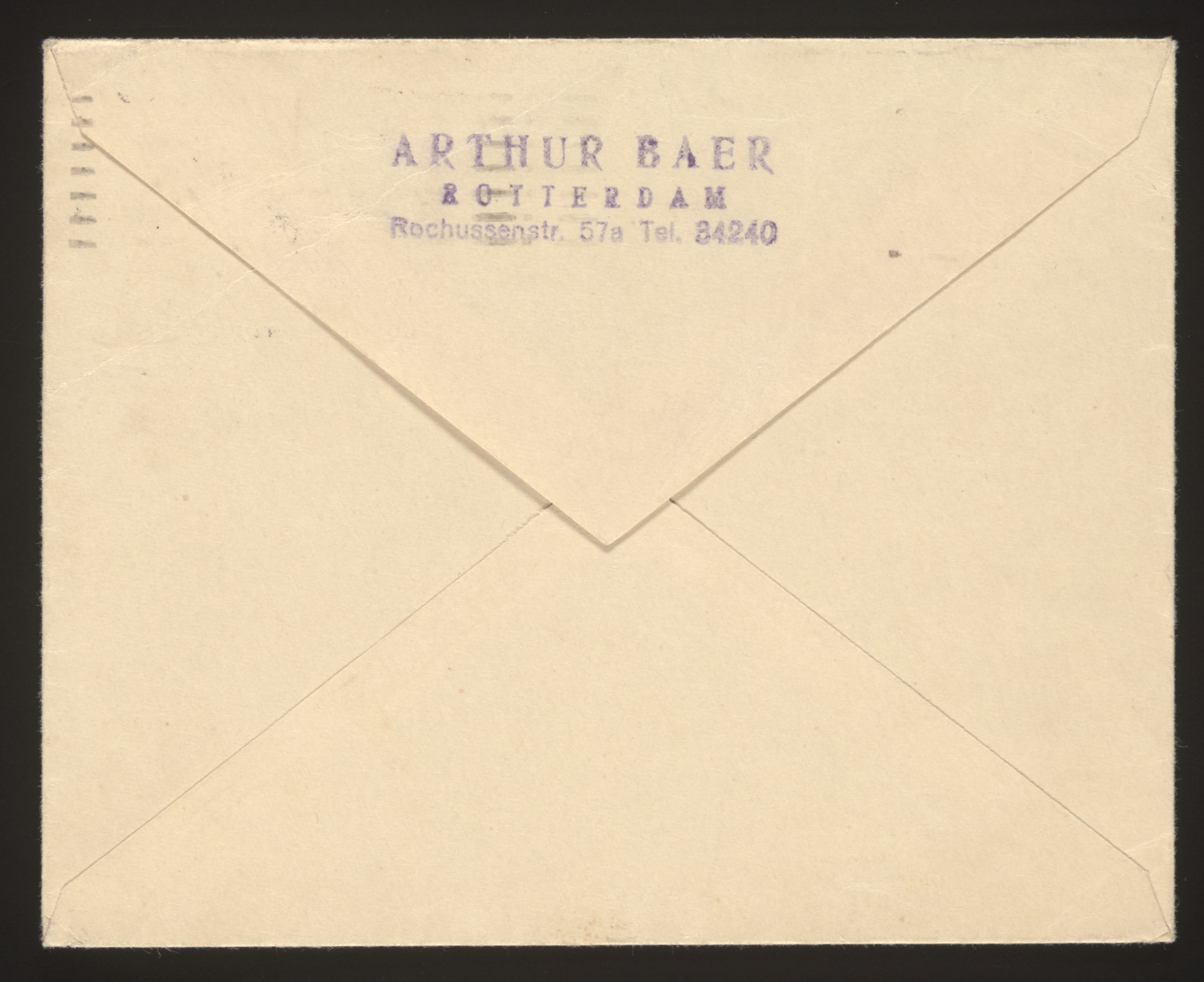
Envelope reverse with return address stamp (Arthur Baer, Rotterdam)
02.1940
Transcribed
None
ARTHUR BAER
ROTTERDAM
Rochussenstr. 57a Tel. 84240
The reverse of the envelope reveals the sender: Arthur Baer, residing at Rochussenstrasse 57a in Rotterdam, Netherlands, with telephone number 84240. The stamped return address (rather than handwritten) suggests Baer was an established resident or businessman in Rotterdam. Rotterdam was one of the last major ports still operating for transatlantic passenger ships in early 1940 — just months before the German invasion of the Netherlands in May 1940 would close this escape route permanently. Baer's correspondence with Mina Kaufmann in New York in February 1940 may relate to arranging transit or shipping passage for the Oppenheimers through Rotterdam. The fate of Arthur Baer himself after the German occupation of the Netherlands in May 1940 is unknown from this document alone.
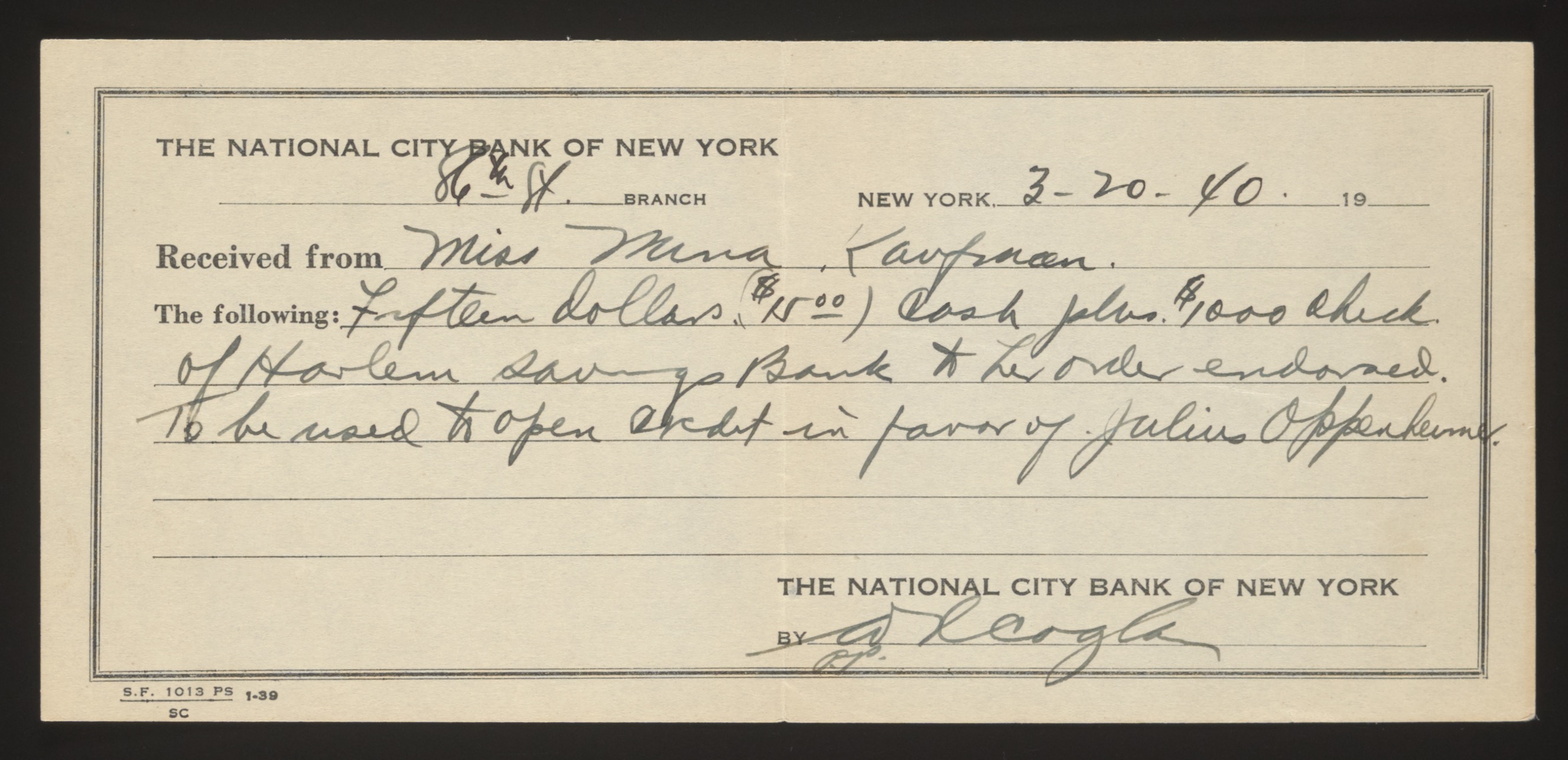
Bank deposit receipt from The National City Bank of New York
20.03.1940
Transcribed
None
THE NATIONAL CITY BANK OF NEW YORK
86th St. BRANCH NEW YORK. 3-20-40. 19
Received from Miss Mina Kaufman.
The following: Fifteen dollars ($15.00) cash plus $1000 check
of Harlem Savings Bank to be order endorsed.
To be used to open credit in favor of Julius Oppenheimer.
THE NATIONAL CITY BANK OF NEW YORK
BY [Signature: G. Leogla [?]]
S.F. 1013 PS 1-39
SC
This bank receipt documents a critical step in the Oppenheimer emigration: Mina Kaufmann depositing $1,015 ($15 in cash plus a $1,000 check from Harlem Savings Bank) at the National City Bank's 86th Street branch to open a letter of credit in favor of Julius Oppenheimer. This letter of credit would have served as proof of financial support for the American immigration authorities and could also be used to purchase transatlantic passage. The amount of $1,000 in 1940 (approximately $22,000 today) was a substantial sum, demonstrating the significant financial commitment required from sponsors. The Harlem Savings Bank check suggests Mina had savings specifically set aside for this purpose. The 86th Street branch location is consistent with the Upper West Side German-Jewish community where Mina and other sponsors lived.
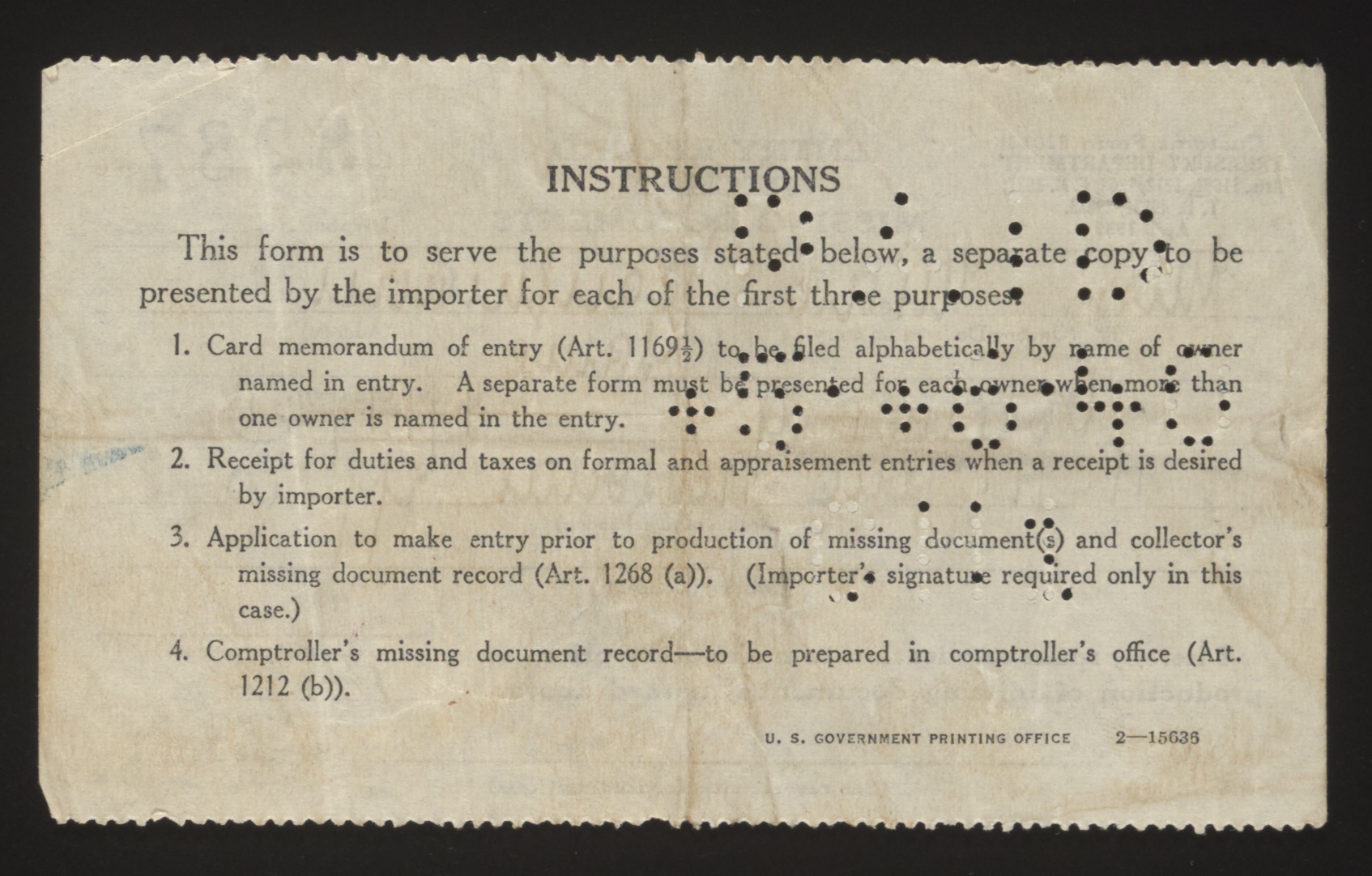
Reverse of U.S. Customs Entry Record form (printed instructions)
04.1940
Transcribed
None
INSTRUCTIONS
This form is to serve the purposes stated below, a separate copy to be
presented by the importer for each of the first three purposes:
1. Card memorandum of entry (Art. 1169½) to be filed alphabetically by name of owner
named in entry. A separate form must be presented for each owner when more than
one owner is named in the entry.
2. Receipt for duties and taxes on formal and appraisement entries when a receipt is desired
by importer.
3. Application to make entry prior to production of missing document(s) and collector's
missing document record (Art. 1268 (a)). (Importer's signature required only in this
case.)
4. Comptroller's missing document record—to be prepared in comptroller's office (Art.
1212 (b)).
U. S. GOVERNMENT PRINTING OFFICE 2—15636
This is the standard printed reverse of U.S. Customs Form 5101, listing four purposes of the form. In this case, purpose 3 was relevant — application to make entry prior to production of missing documents — explaining why Mina Kaufmann signed the front as the importer. The form number 2-15636 and the Government Printing Office imprint date it as a standard pre-war Treasury Department form.
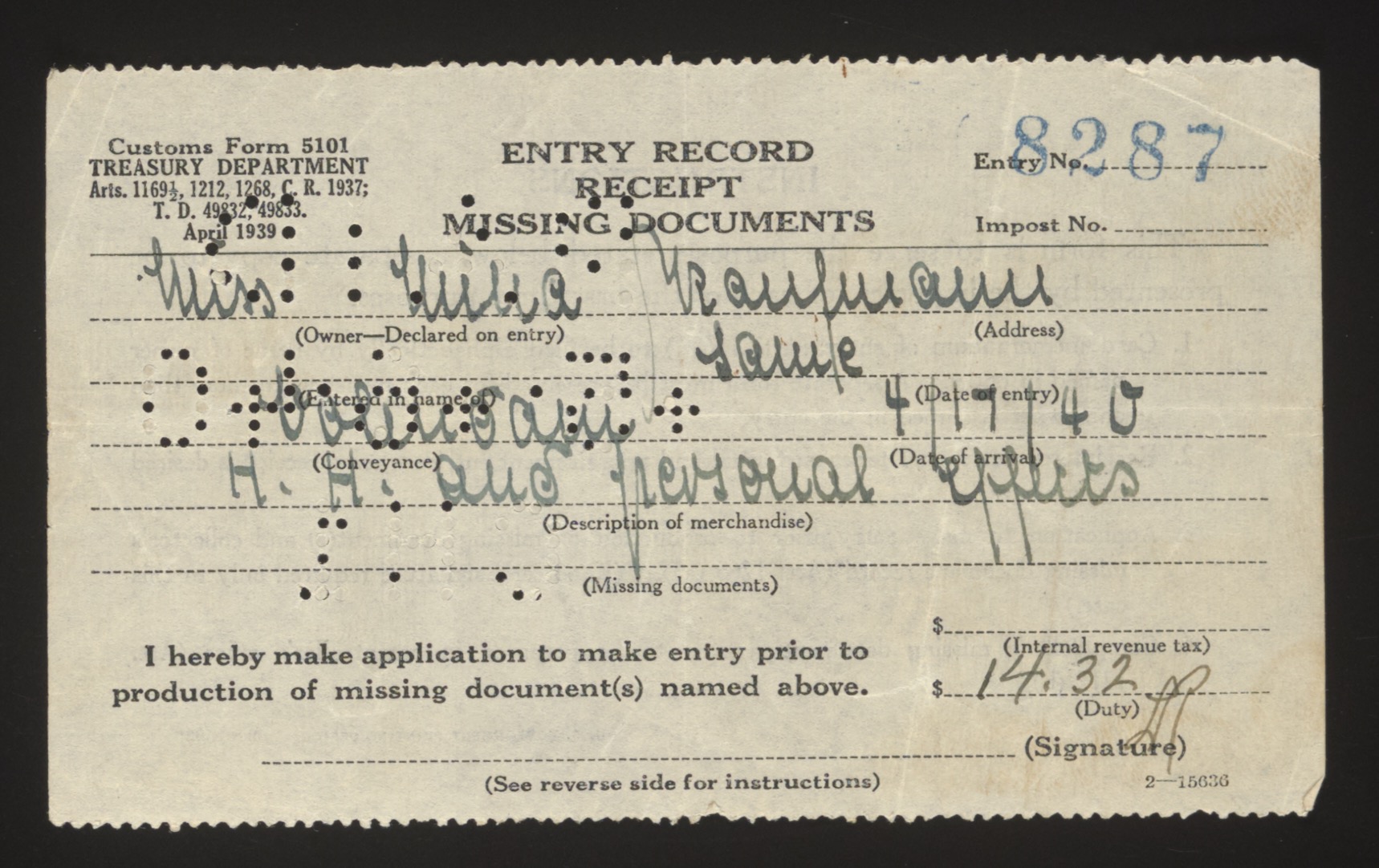
U.S. Customs Entry Record / Receipt / Missing Documents form (Customs Form 5101)
17.04.1940
Transcribed
None
Customs Form 5101
TREASURY DEPARTMENT
Arts. 1169½, 1212, 1268, C. R. 1937;
T. D. 49832, 49833.
April 1939
ENTRY RECORD Entry No. 8287
RECEIPT
MISSING DOCUMENTS Impost No. ________
Miss Mina Kaufmann (Address)
(Owner—Declared on entry) same [?]
* (Entered in name of) (Date of entry)
* [illegible] 4/17/40
(Conveyance) (Date of arrival)
H.H. and personal effects
(Description of merchandise)
(Missing documents)
I hereby make application to make entry prior to $_________ (Internal revenue tax)
production of missing document(s) named above. $ 14.32 (Duty)
(Signature)
(See reverse side for instructions) 2—15636
This U.S. Customs form documents the arrival of the Oppenheimers' shipped belongings in New York on April 17, 1940 — just 13 days after Arthur Baer dispatched them from Rotterdam (see 0014). The shipment was declared by Mina Kaufmann as owner and described as "H.H. and personal effects" (household goods and personal effects). A customs duty of $14.32 was assessed, and entry number 8287 was assigned. The form notes "Missing Documents," indicating that some required paperwork (likely the bill of lading or detailed manifest) had not yet been produced at the time of entry. The relatively quick 13-day transit from Rotterdam to New York via the Holland America Line reflects the efficiency of the route — one of the last functioning transatlantic shipping corridors before the German invasion of the Netherlands closed it permanently on May 10, 1940.
Handwritten receipt (Quittung) from Fanny Hausmann for luggage storage
30.05.1940
Transcribed
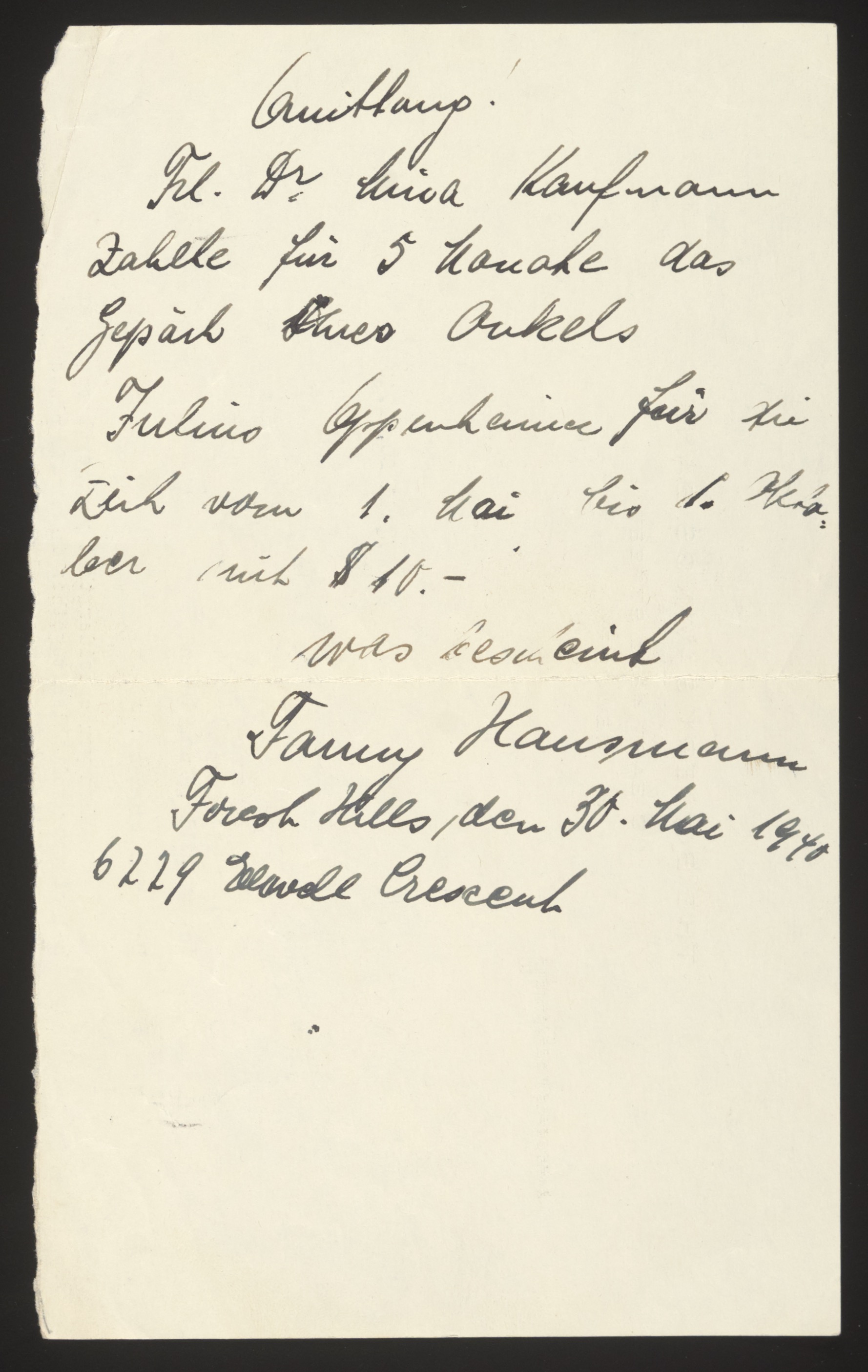
Receipt.
Miss Dr. Mina Kaufmann
paid for 5 months [storage of]
the luggage of her uncle
Julius Oppenheimer for the
period from May 1 to October 1
[in the amount of] $10.—
hereby confirmed
Fanny Hausmann
Forest Hills, May 30, 1940
6229 [or 6299] Elwell Crescent
Quittung.
Frl. Dr. Mina Kaufmann
zahlte für 5 Monate das
Gepäck ihres Onkels
Julius Oppenheimer für die
Zeit vom 1. Mai bis 1. Okto-
ber mit $10.—
wird bescheint [bescheinigt]
Fanny Hausmann
Forest Hills, den 30. Mai 1940
6229 [or 6299] Elwell Crescent
This receipt documents that Fanny Hausmann of Forest Hills, Queens, stored Julius Oppenheimer's shipped luggage for five months (May 1 to October 1, 1940) at a cost of $10, paid by Mina Kaufmann. The address at Elwell Crescent in Forest Hills matches the Fritz Hausmann address on the Bowery Savings Bank letter (0020), confirming that Fanny and Fritz Hausmann were likely a married couple who were part of the extended support network. Mina Kaufmann is referred to as "Frl. Dr." (Fräulein Doktor — Miss Doctor), indicating she held a doctoral degree — an unusual distinction for a woman of that era. Julius Oppenheimer is described as Mina's uncle ("ihres Onkels"), confirming the family relationship. The fact that the luggage arrived in New York by April 17 (see 0016) but the Oppenheimers themselves had not yet arrived by May 30, 1940, underscores the agonizing gap between rescuing possessions and rescuing people.
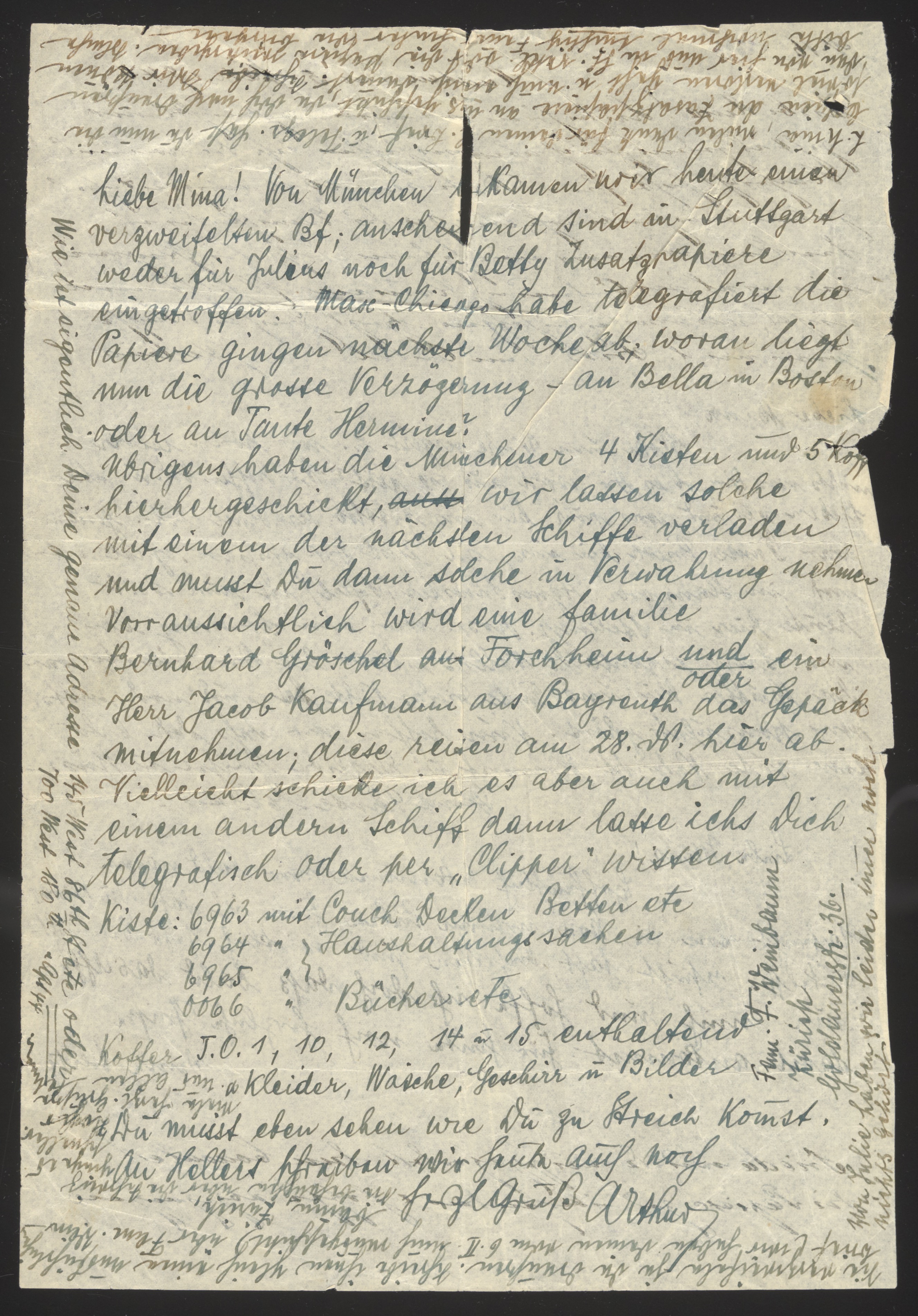
Handwritten letter discussing shipping of belongings, with inventory
1940
Transcribed
Dear Mina! From Munich we received a desperate letter today, and in Stuttgart still nothing for Betty's passport photographs has arrived. [Someone] telegraphed this week that the journey would depart next week — what is causing the great delay — Bella in Boston or Aunt Hermine?
By the way, the Munich [relatives] have sent 4 crates and 5 kg here, and we will have them loaded on one of the next ships, and you will then need to take them into storage. A family named Bernhard Göschel from Forchheim and a Mr. Jacob Kaufmann from Bayreuth will presumably bring the luggage or take it along; they depart on the 28th. Perhaps it will be sent on another ship, in which case I will let you know by telegram or by "Clipper" [airmail].
Crate: 6963 — with couch/bedding, beds, etc.
6964 — Household items
6965 — [contents not specified]
6966 — Book crate
Suitcases: I.O. 1, 10, 12, 14–18 containing clothes, linens, paintings and pictures
You must see how you can get to Erich.
[The] Kellers say how glad they are!
Warm greetings, Arthur
[Main body:]
Liebe Mina! Von München [?] bekommen wir heute einen verzweifelten [?] Brief, und in Stuttgart weiter für [?] noch für Betty Lustphotographire eingetroffen. Man [?] diese woche telegraphiert die Fahrt [?] gingen nächste Woche ab, woran liegt nun die grosse Verzögerung — an Bella in Boston oder an Tante Hermine?
Übrigens haben die Münchener 4 Kisten und 5 Kg hierhergeschickt, und wir lassen solche mit einem der nächsten Schiffe verladen und musst Du dann solche in Verwahrung nehmen. Voraussichtlich wird eine Familie Bernhard Göschel aus Forchheim und ein Herr Jacob Kaufmann aus Bayreuth das Gepäck oder mitnehmen; diese reisen am 28. [?] hier ab. Vielleicht schicken es aber auch mit einem anderen Schiff dann lasse ich Dich telegrafisch oder per "Clipper" wissen.
Kiste: 6963 mit Couch betten Betten etc.
6964 — Haushaltungssachen
6965 —
6966 — Bücherkiste
Koffer: I.O.1, 10, 12, 14–18 enthaltend Kleider, Wäsche, Gemälde u. Bilder
[?] du musst eben sehen wie Du zu Erich Komest.
[?] Kellers sprechen Wie froh sind wir!
herzl. Grüsse Arthur
This letter documents the logistics of shipping household belongings out of Germany — a critical aspect of Jewish emigration. The Oppenheimers were sending crated possessions via ship to the United States through intermediaries. The mention of passport photographs, "Clipper" airmail, and the urgency about delays reflects the desperate race to emigrate. Bernhard Göschel from Forchheim and Jacob Kaufmann from Bayreuth appear to be fellow Jewish emigrants carrying luggage on the same ship. The detailed inventory of crates and suitcases preserves a record of what the family tried to save from their household.
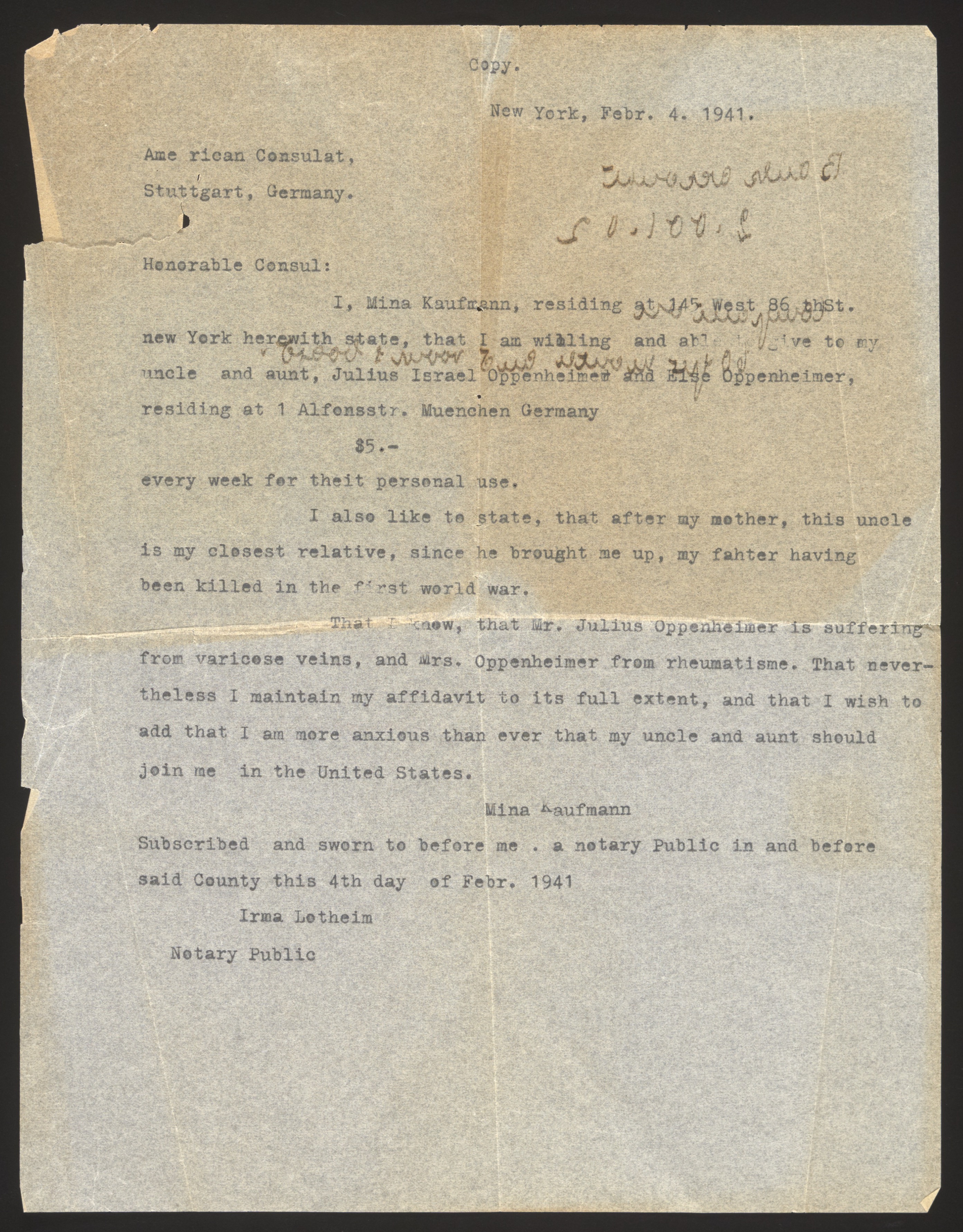
Typed letter/affidavit from Mina Kaufmann to the American Consulate in Stuttg...
04.02.1941
Transcribed
None
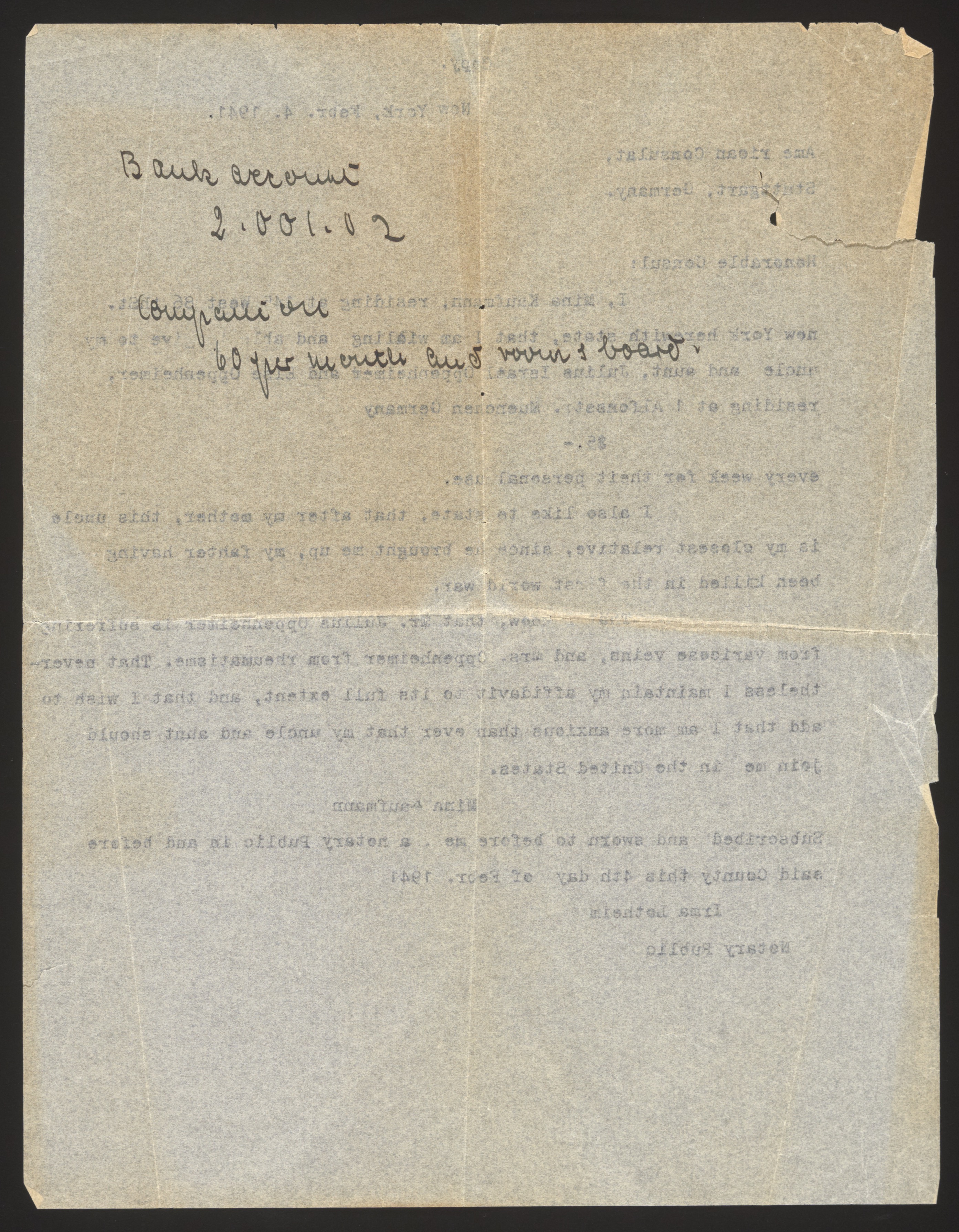
Copy.
New York, Febr. 4. 1941.
Ame rican Consulat,
Stuttgart, Germany. [Handwritten annotations: illegible]
Honorable Consul:
I, Mina Kaufmann, residing at 145 West 86 Str.
new York herewith state, that I am willing and abl[e] [to gi]ve to my
uncle and aunt, Julius Israel Oppenheimer and Elsa Oppenheimer,
residing at 1 Alfonsstr. Muenchen Germany
$5.—
every week for their personal use.
I also like to state, that after my mother, this uncle
is my closest relative, since he brought me up, my father having
been killed in the first world war.
That I know, that Mr. Julius Oppenheimer is suffering
from varicose veins, and Mrs. Oppenheimer from rheumatism. That never-
theless I maintain my affidavit to its full extent, and that I wish to
add that I am more anxious than ever that my uncle and aunt should
join me in the United States.
Mina Kaufmann
Subscribed and sworn to before me, a notary Public in and before
said County this 4th day of Febr. 1941
Irma Lotheim
Notary Public
This is perhaps the most personal document in the entire collection. Mina Kaufmann — the central figure coordinating the rescue effort from New York — reveals her own family connection: Julius Oppenheimer is her uncle and closest living relative after her mother. She explains that Julius "brought me up" because her father was killed in the First World War. This biographical detail transforms our understanding of the entire correspondence: Mina's tireless efforts — coordinating multiple sponsors, depositing $1,015 at the bank, paying for affidavit filings, arranging luggage storage — were driven not just by family obligation but by a deep personal debt to the uncle who raised her after she was orphaned by war. Her promise of $5 per week (about $107/week today) for personal expenses supplemented the full board and lodging promised by the Langerbeins and Samuel Morris. Like Morris and Langerbein before her, she explicitly acknowledges the Oppenheimers' health conditions (varicose veins and rheumatism) and maintains her affidavit "nevertheless" — the same formula used to counter the consulate's potential objection to admitting immigrants with medical conditions. The document is dated February 4, 1941 — three days after the Langerbein affidavit — suggesting a coordinated blitz of paperwork aimed at finally securing the visas. Notarized by Irma Lotheim.
Reverse of Mina Kaufmann's letter to the American Consulate (carbon copy back)
04.02.1941
Transcribed
None
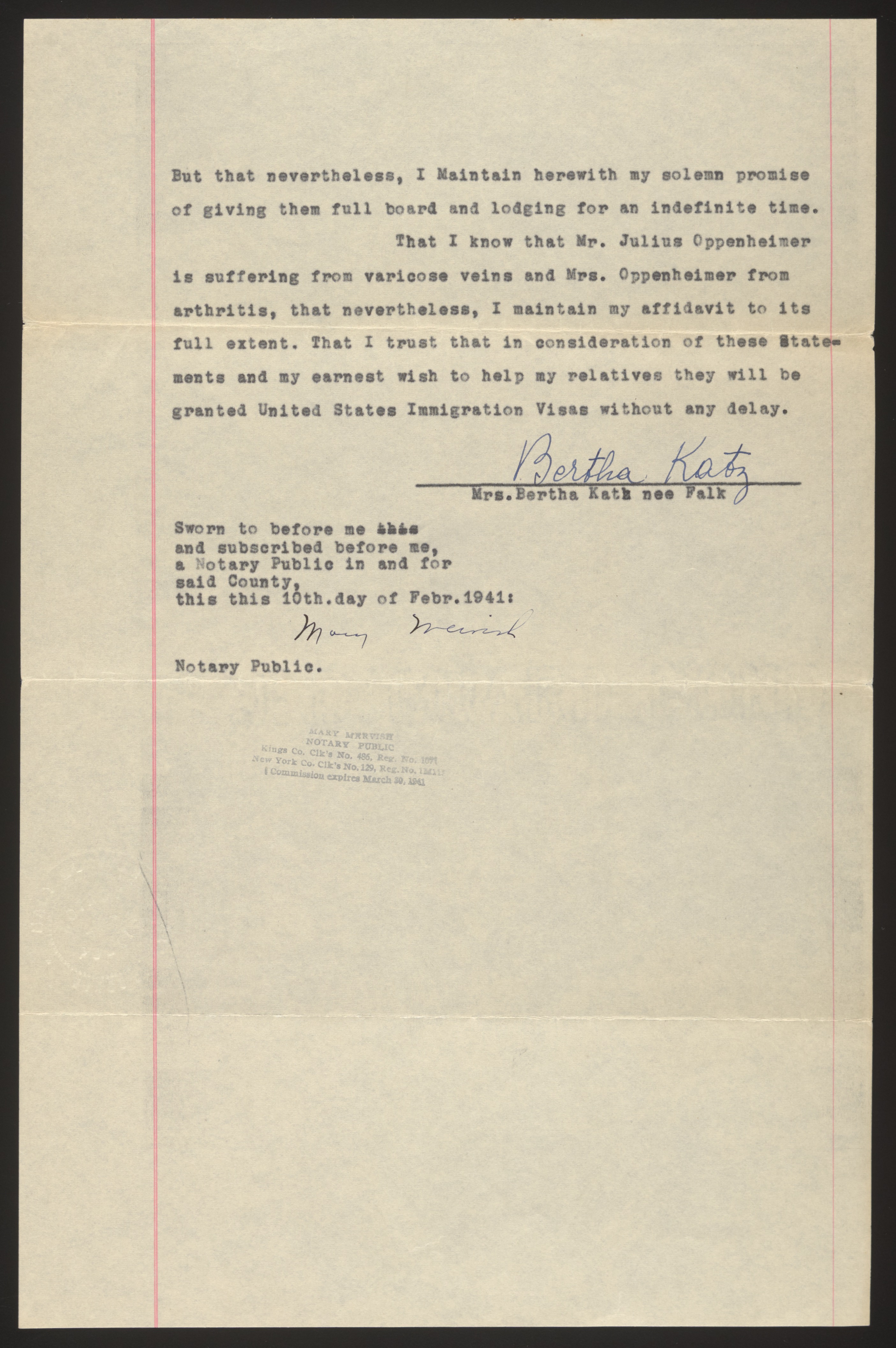
[Reverse of carbon copy — text from front visible in mirror image]
[Handwritten annotations at top, partially legible:]
Zuversicht auch ct [?]
S.V.100.S [?]
[Handwritten text:]
Good I know and above my [?] [partially legible]
This is the reverse of Mina Kaufmann's February 4, 1941 letter to the American Consulate (0025). The document appears to be a carbon copy, with the front text visible in reverse through the thin paper. A few handwritten annotations are visible but largely illegible — possibly filing notes or reference numbers added later. The document was preserved as part of the complete record of the Oppenheimer visa application.
Typed formal affidavit of support from Mrs. Bertha Katz née Falk (page 2 of 2)
10.02.1941
Transcribed
None
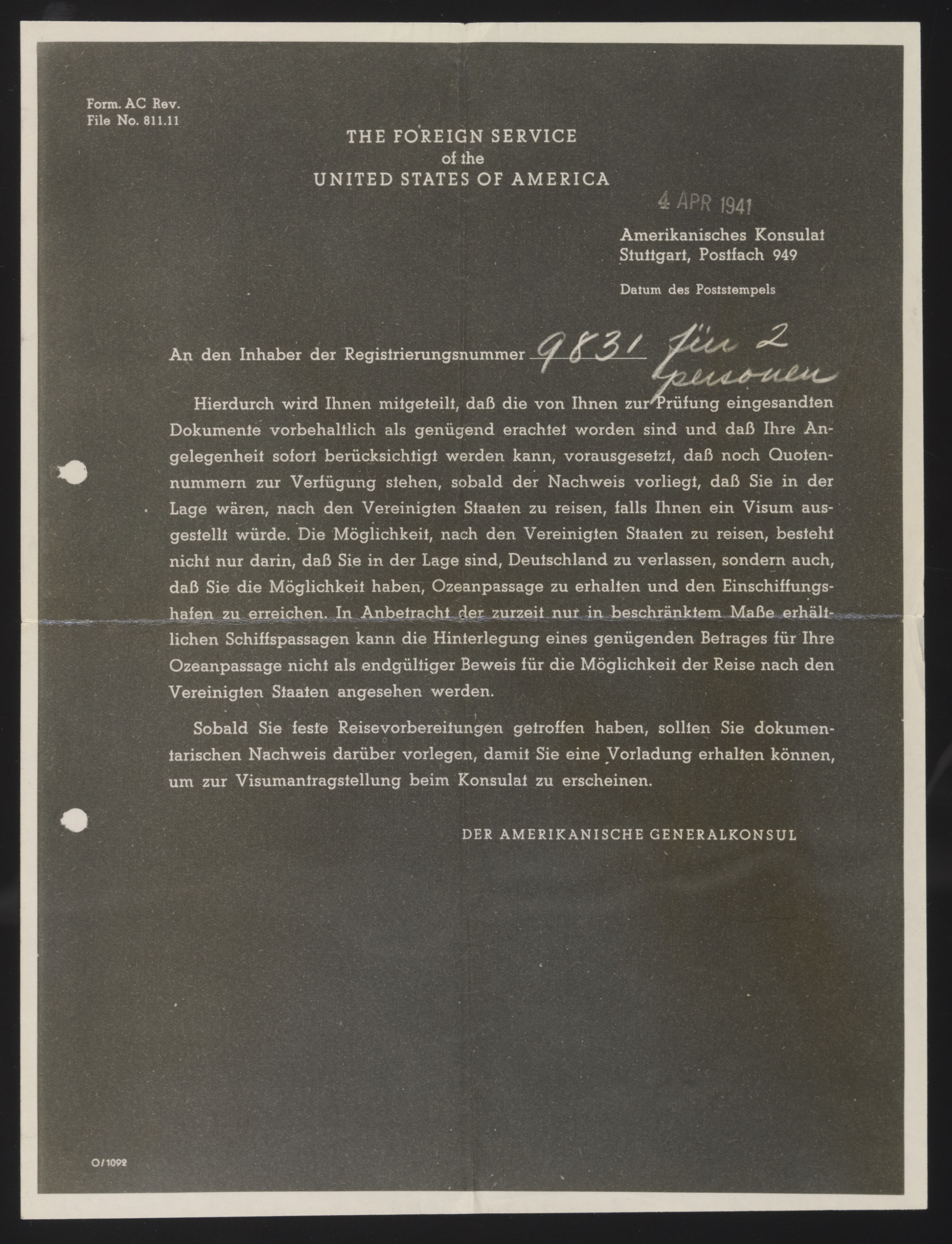
But that nevertheless, I Maintain herewith my solemn promise
of giving them full board and lodging for an indefinite time.
That I know that Mr. Julius Oppenheimer
is suffering from varicose veins and Mrs. Oppenheimer from
arthritis, that nevertheless, I maintain my affidavit to its
full extent. That I trust that in consideration of these State-
ments and my earnest wish to help my relatives they will be
granted United States Immigration Visas without any delay.
Bertha Katz
Mrs. Bertha Katz nee Falk
Sworn to before me and
and subscribed before me,
a Notary Public in and for
said County,
this this 10th.day of Febr.1941:
Mary Meurich
Notary Public.
[Notary stamp:]
MARY MEURICH
NOTARY PUBLIC
Kings Co. Clk's No. 88, Reg. No. 1097
New York Co. Clk's No. 139, Reg. No. 1M117
Commission expires March 30, 1941
The conclusion of Bertha Katz's affidavit follows the same pattern as the other sponsors: acknowledging Julius's varicose veins and Mrs. Oppenheimer's health condition (here described as "arthritis" rather than "rheumatism" as in other documents — likely the same condition described differently) and maintaining the affidavit "nevertheless." Her promise of "full board and lodging for an indefinite time" goes further than the other sponsors' time-limited commitments. The document was notarized on February 10, 1941, by Mary Meurich, a notary registered in both Kings County (Brooklyn) and New York County (Manhattan), whose commission was set to expire just weeks later on March 30, 1941. This affidavit was part of the coordinated February 1941 push — Langerbein on Feb 1, Mina Kaufmann on Feb 4, and Bertha Katz on Feb 10 — that finally produced the Stuttgart consulate's positive response in April 1941 (see 0029).
Official letter from the American Consulate General in Stuttgart to the Oppen...
04.04.1941
Transcribed
Form AC Rev.
File No. 811.11
THE FOREIGN SERVICE
of the
UNITED STATES OF AMERICA
American Consulate
Stuttgart, P.O. Box 949
4 APR 1941
Date of postmark
To the holder of registration number 9831 for 2 persons
You are hereby informed that the documents you submitted for review have been
provisionally deemed sufficient, and that your case can be processed immediately,
provided that quota numbers are still available, as soon as proof is furnished that you
would be in a position to travel to the United States if a visa were issued to you. The
ability to travel to the United States consists not only of being able to leave Germany,
but also of having the possibility of obtaining ocean passage and reaching the port of
embarkation. In view of the currently limited availability of ship passages, the deposit
of a sufficient amount for your ocean passage cannot be regarded as final proof of the
ability to travel to the United States.
As soon as you have made firm travel arrangements, you should submit documentary
proof thereof, so that you may receive a summons to appear at the Consulate for your
visa application.
THE AMERICAN CONSUL GENERAL
O/1009
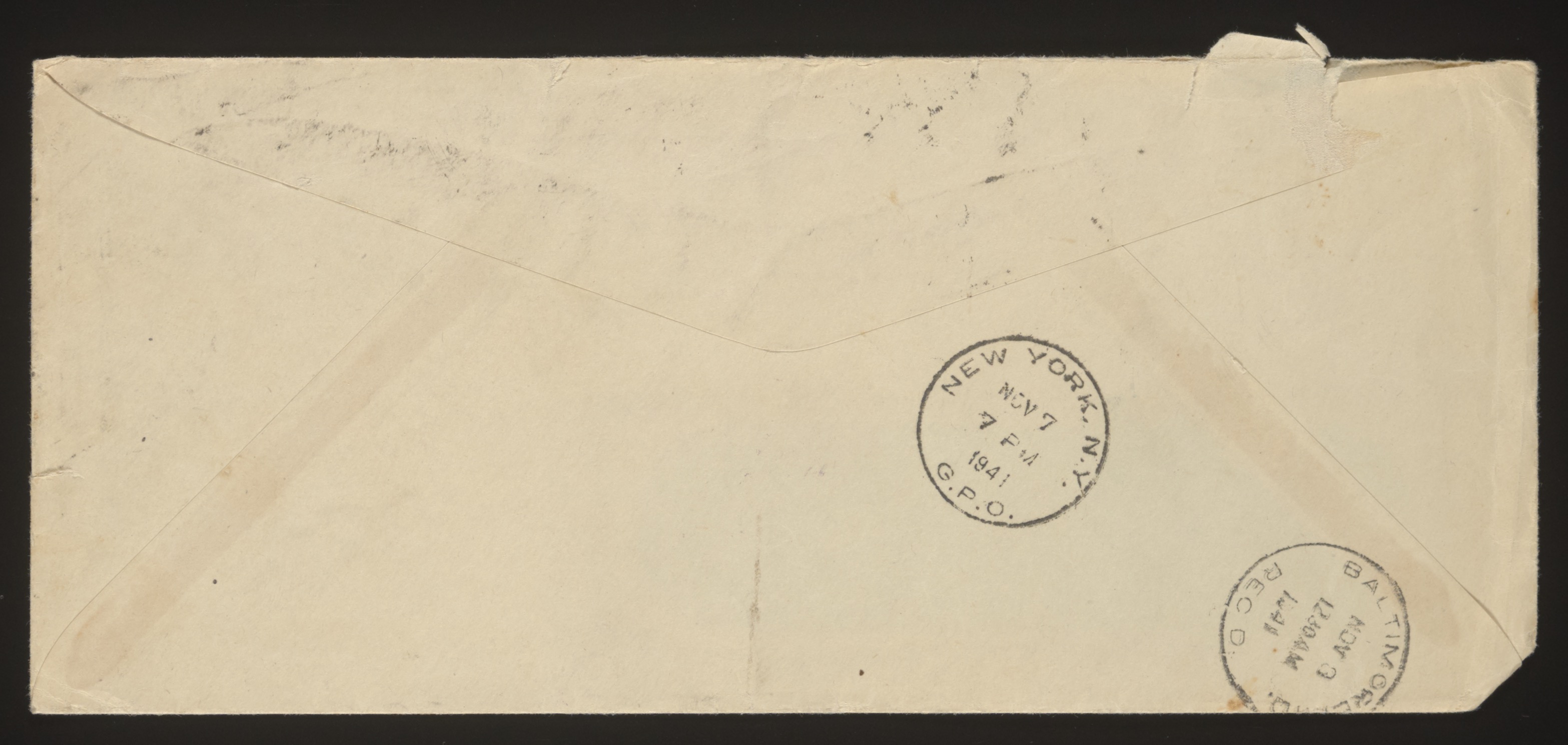
Form. AC Rev.
File No. 811.11
THE FOREIGN SERVICE
of the
UNITED STATES OF AMERICA
Amerikanisches Konsulat
Stuttgart, Postfach 949
4 APR 1941
Datum des Poststempels
An den Inhaber der Registrierungsnummer 9831 für 2 Personen
Hierdurch wird Ihnen mitgeteilt, daß die von Ihnen zur Prüfung eingesandten
Dokumente vorbehaltlich als genügend erachtet worden sind und daß Ihre An-
gelegenheit sofort berücksichtigt werden kann, vorausgesetzt, daß noch Quoten-
nummern zur Verfügung stehen, sobald der Nachweis vorliegt, daß Sie in der
Lage wären, nach den Vereinigten Staaten zu reisen, falls Ihnen ein Visum aus-
gestellt würde. Die Möglichkeit, nach den Vereinigten Staaten zu reisen, besteht
nicht nur darin, daß Sie in der Lage sind, Deutschland zu verlassen, sondern auch,
daß Sie die Möglichkeit haben, Ozeanpassage zu erhalten und den Einschiffungs-
hafen zu erreichen. In Anbetracht der zurzeit nur in beschränktem Maße erhält-
lichen Schiffspassagen kann die Hinterlegung eines genügenden Betrages für Ihre
Ozeanpassage nicht als endgültiger Beweis für die Möglichkeit der Reise nach den
Vereinigten Staaten angesehen werden.
Sobald Sie feste Reisevorbereitungen getroffen haben, sollten Sie dokumen-
tarischen Nachweis darüber vorlegen, damit Sie eine Vorladung erhalten können,
um zur Visumantragstellung beim Konsulat zu erscheinen.
DER AMERIKANISCHE GENERALKONSUL
O/1009
This is the pivotal document in the entire collection — the American Consulate's response to over a year of accumulated affidavits and sponsorship documentation. Dated April 4, 1941, the Stuttgart consulate acknowledges that the Oppenheimers' paperwork has been "provisionally deemed sufficient" (registration 9831 for 2 persons) — a hard-won victory after affidavits from Samuel Morris, Mina Kaufmann, William and Ottilie Langerbein, and Bertha Katz. However, the letter immediately imposes a devastating new condition: the Oppenheimers must prove they can actually travel to the United States. The consulate explicitly notes that this means not just leaving Germany, but obtaining ocean passage and reaching the port of embarkation — an increasingly impossible requirement by April 1941. With the Netherlands, Belgium, and France under German occupation, traditional embarkation ports were closed. The consulate further states that merely depositing money for passage is not sufficient — firm travel arrangements must be documented. This Catch-22 — visas granted only upon proof of travel arrangements that required visas to obtain — was a bureaucratic trap that ensnared thousands of would-be refugees. By mid-1941, the U.S. State Department under Breckinridge Long was actively using such procedural barriers to restrict Jewish immigration. Whether Julius and Elsa Oppenheimer were ultimately able to satisfy this final condition and escape is the central question left unresolved by this document.
Reverse of Zaro Tours Special Delivery envelope with transit postmarks
1941
Transcribed
None
[Postal transit marks:]
[Circular postmark:] NEW YORK, N.Y. / NOV 7 / A P.M. / 1941 / G.P.O.
[Circular postmark, partially visible:] BALTIMORE [MD] / NOV 8 [?] / 12:30 M / 1941 / REC'D
The reverse of the Zaro Tours envelope shows the postal transit route: dispatched from the New York General Post Office on the afternoon of November 7, 1941, and received in Baltimore on November 8, 1941, at approximately 12:30 PM — overnight delivery consistent with Special Delivery service between New York and Baltimore. The Baltimore destination confirms that Mina Kaufmann had relocated from New York City to Baltimore (c/o Engel, 4006 Norfolk Avenue), as indicated in the Zaro Tours letter (0035). Her move from New York may reflect a change in personal circumstances — she had lived at 145 West 86th Street for years before this.
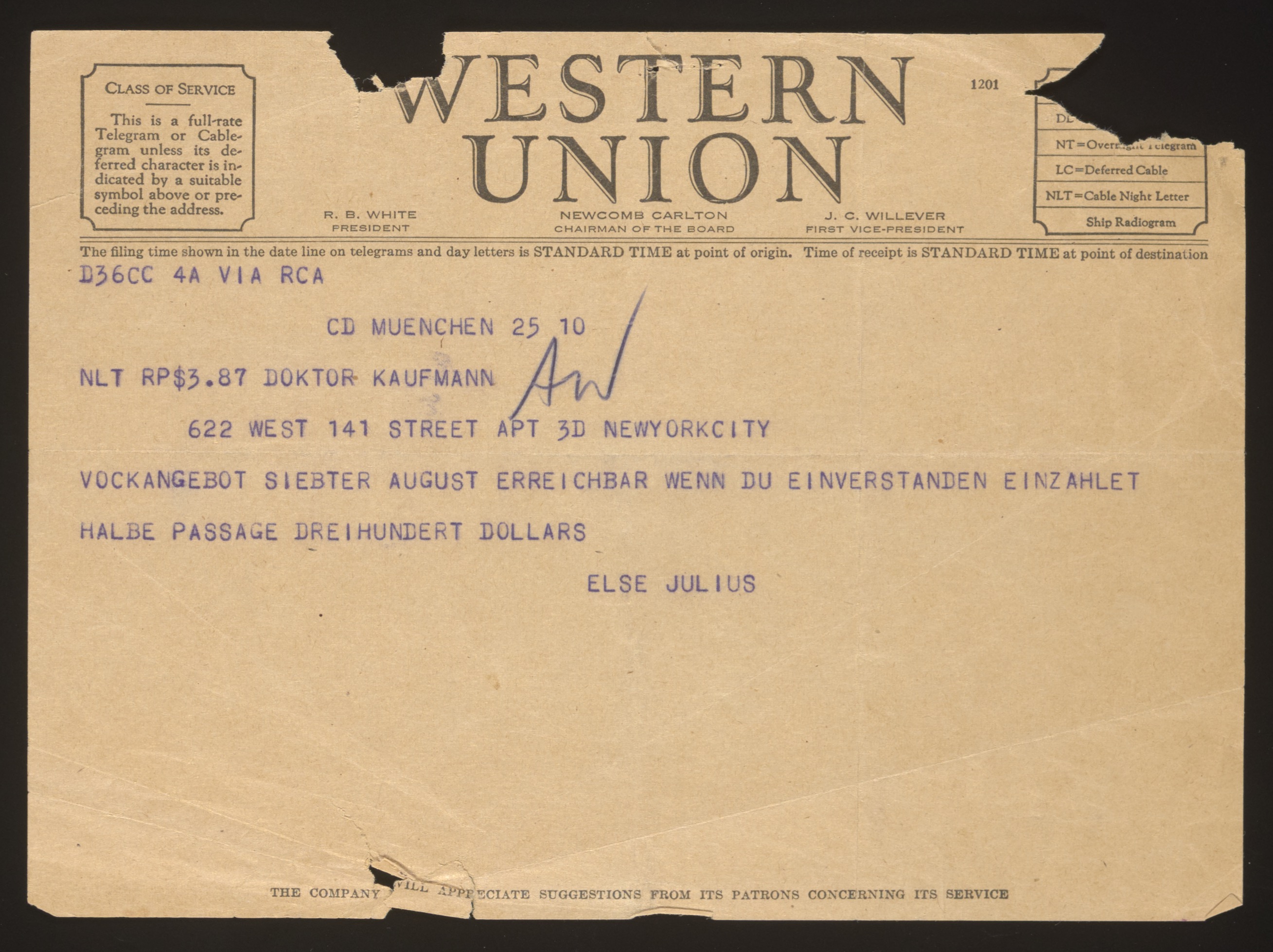
Western Union telegram from Julius and Elsa Oppenheimer in Munich to Mina Kau...
25.10.1941
Transcribed
[From Munich, October 25:]
To: DOKTOR KAUFMANN
622 WEST 141 STREET APT 3D, NEW YORK CITY
VOCK OFFER SEVENTH AUGUST REACHABLE IF YOU AGREE DEPOSIT
HALF PASSAGE THREE HUNDRED DOLLARS
ELSE [AND] JULIUS
[WESTERN UNION header]
R. B. WHITE, PRESIDENT NEWCOMB CARLTON, CHAIRMAN OF THE BOARD J. C. WILLEVER, FIRST VICE-PRESIDENT
The filing time shown in the date line on telegrams and day letters is STANDARD TIME at point of origin.
Time of receipt is STANDARD TIME at point of destination.
D36CC 4A VIA RCA
CD MUENCHEN 25 10
NLT RP$3.87 DOKTOR KAUFMANN [handwritten: AW]
622 WEST 141 STREET APT 3D NEWYORKCITY
VOCKANGEBOT SIEBTER AUGUST ERREICHBAR WENN DU EINVERSTANDEN EINZAHLET
HALBE PASSAGE DREIHUNDERT DOLLARS
ELSE JULIUS
THE COMPANY WILL APPRECIATE SUGGESTIONS FROM ITS PATRONS CONCERNING ITS SERVICE
This telegram — one of the very few direct communications from Julius and Elsa Oppenheimer themselves in the entire collection — was sent from Munich, likely on October 25, 1941 (based on the routing code "MUENCHEN 25 10"). Julius and Elsa inform Mina ("Doktor Kaufmann") that a travel offer from Reisebüro Vock (a Stuttgart travel agency — see 0037 and 0040) is available, with a departure date reachable by August 7th [likely a reference to a ship sailing]. They ask Mina to deposit $300 — half the passage fare — if she agrees. The telegram was sent to Mina's new address at 622 West 141st Street, Apt. 3D, New York City (c/o Heller, as per the Zaro Tours documents). The fact that Julius and Elsa could still send international telegrams from Munich in late October 1941 indicates they had not yet been deported, but the window was closing rapidly. Deportations of Munich Jews to Kaunas (Lithuania) and Riga (Latvia) began on November 20, 1941. The telegram is signed "ELSE JULIUS" — Elsa's name first — suggesting she may have been the one managing the practical arrangements from the Munich end.
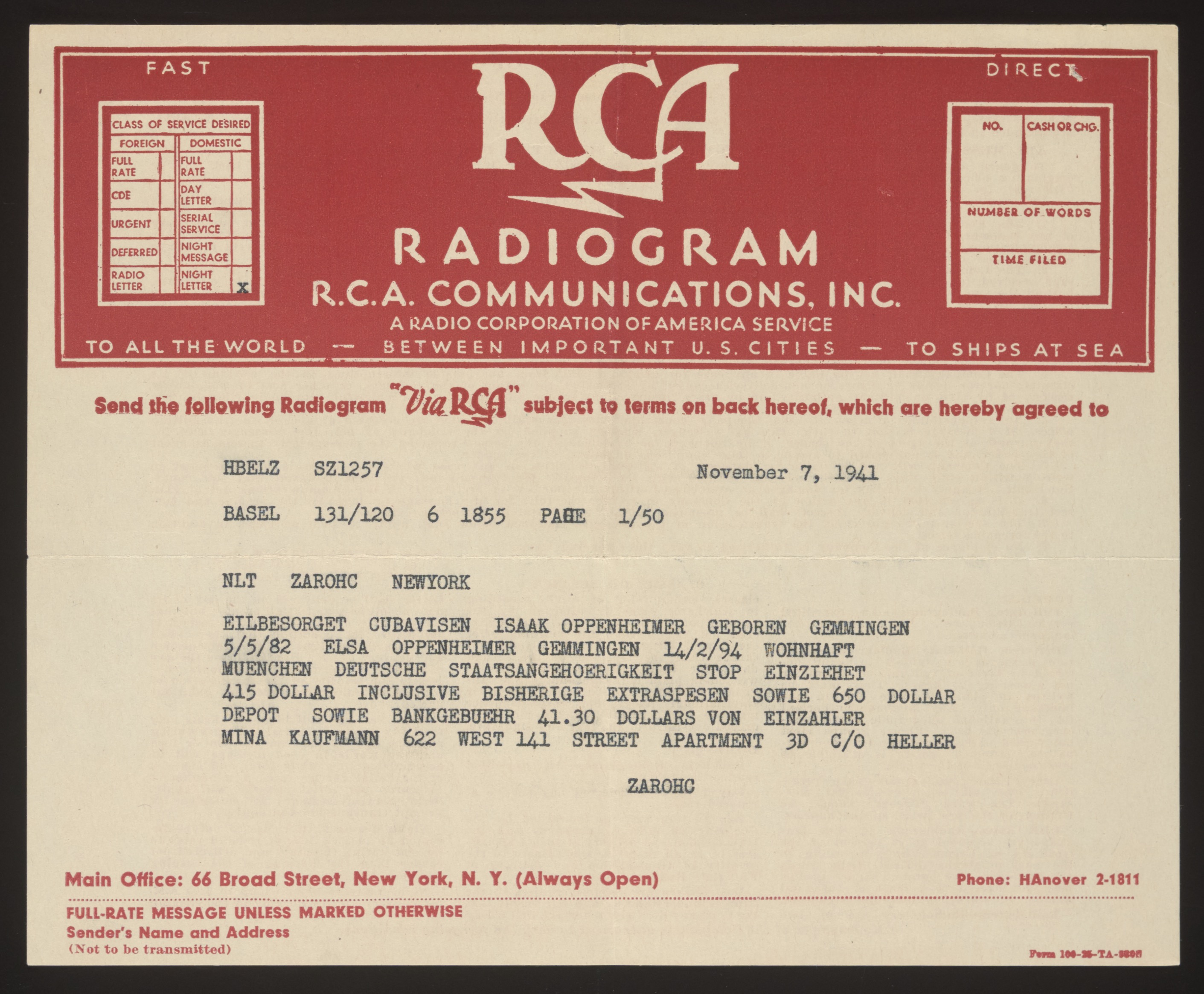
RCA Radiogram (telegram) from Zaro Tours Basel branch to Zaro Tours New York,...
07.11.1941
Transcribed
[Cable from Zaro Tours Basel to Zaro Tours New York:]
URGENTLY ARRANGE CUBA VISAS [for] ISAAK OPPENHEIMER BORN GEMMINGEN
5/5/82 [and] ELSA OPPENHEIMER [born] GEMMINGEN 14/2/94 RESIDENT [of]
MUNICH GERMAN NATIONALITY STOP COLLECT
415 DOLLARS INCLUDING PREVIOUS EXTRA EXPENSES AS WELL AS 650 DOLLARS
DEPOSIT AS WELL AS BANK FEE 41.30 DOLLARS FROM DEPOSITOR
MINA KAUFMANN 622 WEST 141 STREET APARTMENT 3D C/O HELLER
ZAROHC [Zaro Tours]
[RCA RADIOGRAM header — R.C.A. COMMUNICATIONS, INC.]
[A RADIO CORPORATION OF AMERICA SERVICE]
[TO ALL THE WORLD — BETWEEN IMPORTANT U.S. CITIES — TO SHIPS AT SEA]
Send the following Radiogram "Via RCA" subject to terms on back hereof, which are hereby agreed to
HBELZ SZ1257 November 7, 1941
BASEL 131/120 6 1855 PAHE 1/50
NLT ZAROHC NEWYORK
EILBESORGET CUBAVISEN ISAAK OPPENHEIMER GEBOREN GEMMINGEN
5/5/82 ELSA OPPENHEIMER GEMMINGEN 14/2/94 WOHNHAFT
MUENCHEN DEUTSCHE STAATSANGEHOERIGKEIT STOP EINZIEHET
415 DOLLAR INCLUSIVE BISHERIGE EXTRASPESEN SOWIE 650 DOLLAR
DEPOT SOWIE BANKGEBUEHR 41.30 DOLLARS VON EINZAHLER
MINA KAUFMANN 622 WEST 141 STREET APARTMENT 3D C/O HELLER
ZAROHC
Main Office: 66 Broad Street, New York, N.Y. (Always Open) Phone: HAnover 2-1811
FULL-RATE MESSAGE UNLESS MARKED OTHERWISE
Sender's Name and Address
(Not to be transmitted) Form 100-38-TA-0840
This radiogram marks a dramatic shift in the rescue strategy. By November 1941, with direct U.S. immigration still blocked by the Stuttgart consulate's travel-proof requirement (see 0029), the plan pivoted to obtaining Cuba visas — a last-resort escape route. The cable was sent from Zaro Tours' Basel, Switzerland branch to their New York office (cable address ZAROHC), urgently requesting Cuba visas for "Isaak" (Julius Israel) Oppenheimer and Elsa Oppenheimer. The financial breakdown totals $1,106.30: $415 for costs and expenses, $650 for a deposit, and $41.30 in bank fees, all to be collected from Mina Kaufmann — now residing at 622 West 141st Street, Apt. 3D, c/o Heller (she had moved from her longtime 145 West 86th Street address). The use of "Isaak" instead of "Julius" likely reflects the forced adoption of the middle name "Israel" imposed on Jewish men by the Nazi regime's August 1938 decree. The date — November 7, 1941, exactly one month before Pearl Harbor (December 7, 1941) and the subsequent U.S. declaration of war on Germany — places this cable in the final weeks when any transatlantic rescue was theoretically possible. Cuba had been an alternate refuge for Jewish refugees since the famous St. Louis voyage of 1939, though by late 1941, Cuba's own immigration restrictions had tightened considerably.
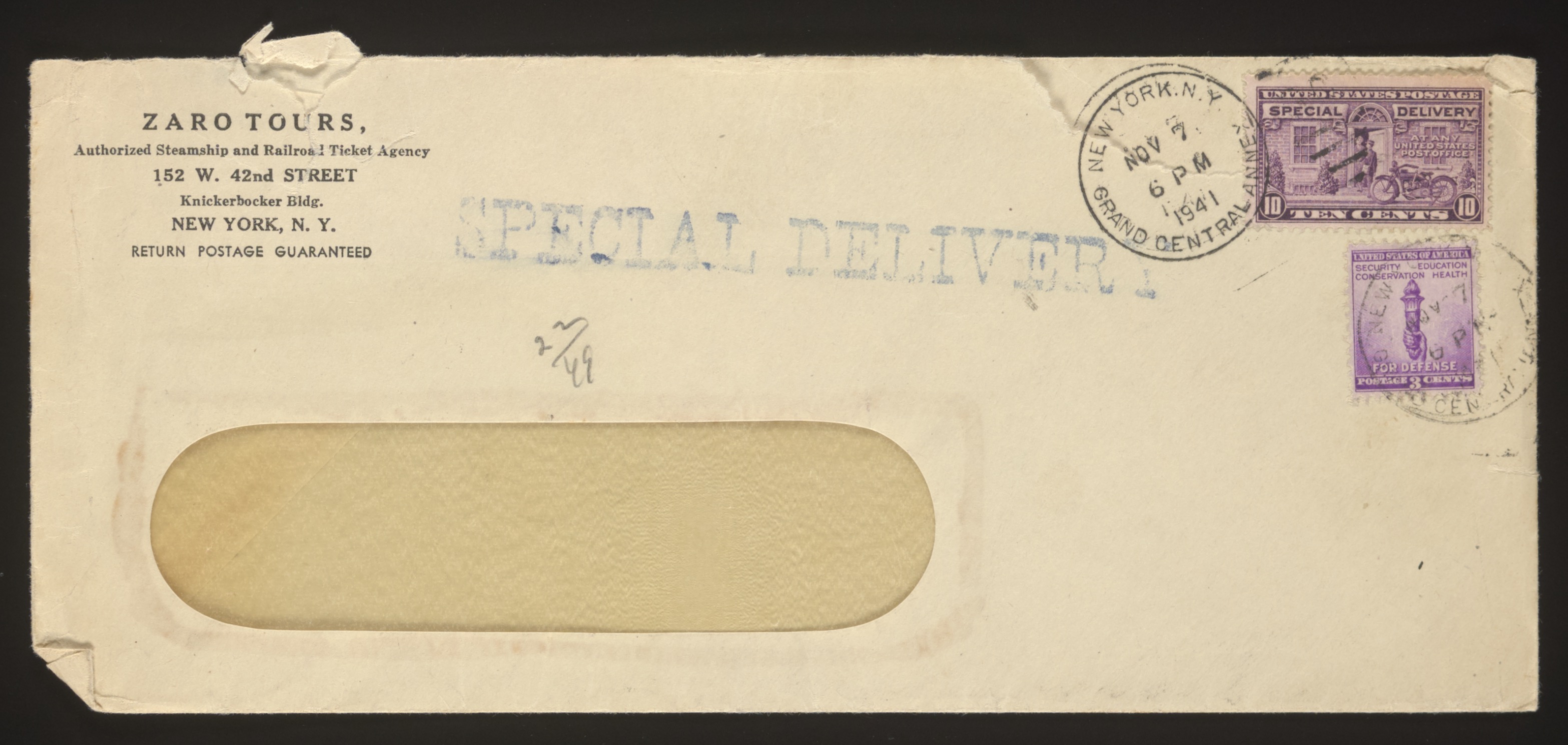
Special Delivery envelope from Zaro Tours, New York, to Mina Kaufmann in Balt...
07.11.1941
Transcribed
None
[Return address, printed:]
ZARO TOURS,
Authorized Steamship and Railroad Ticket Agency
152 W. 42nd STREET
Knickerbocker Bldg.
NEW YORK, N. Y.
RETURN POSTAGE GUARANTEED
[Rubber stamp across center:] SPECIAL DELIVERY
[Handwritten:] 2/69 [?]
[Postmark:] NEW YORK, N.Y. / NOV 7 / 6 PM / 1941 / GRAND CENTRAL
[10-cent Special Delivery stamp — motorcycle courier design]
[3-cent "For Defense" stamp — Statue of Liberty / "Security Education Conservation Health"]
[Window envelope — recipient address visible through window]
This Special Delivery envelope from Zaro Tours — an authorized steamship and railroad ticket agency at 152 West 42nd Street in the Knickerbocker Building, Manhattan — carried the urgent Cuba visa proposal to Mina Kaufmann. The Special Delivery service (requiring a 10-cent stamp in addition to regular postage) guaranteed same-day delivery by messenger, reflecting the extreme urgency of the matter. The envelope was posted at 6 PM on November 7, 1941, from the Grand Central Station post office. The 3-cent "For Defense" stamp depicting the Statue of Liberty — symbol of American liberty and refuge — carries a bitter irony given the contents of the letter inside: a last-ditch attempt to route Jewish refugees through Cuba because direct entry to the United States had been effectively blocked.
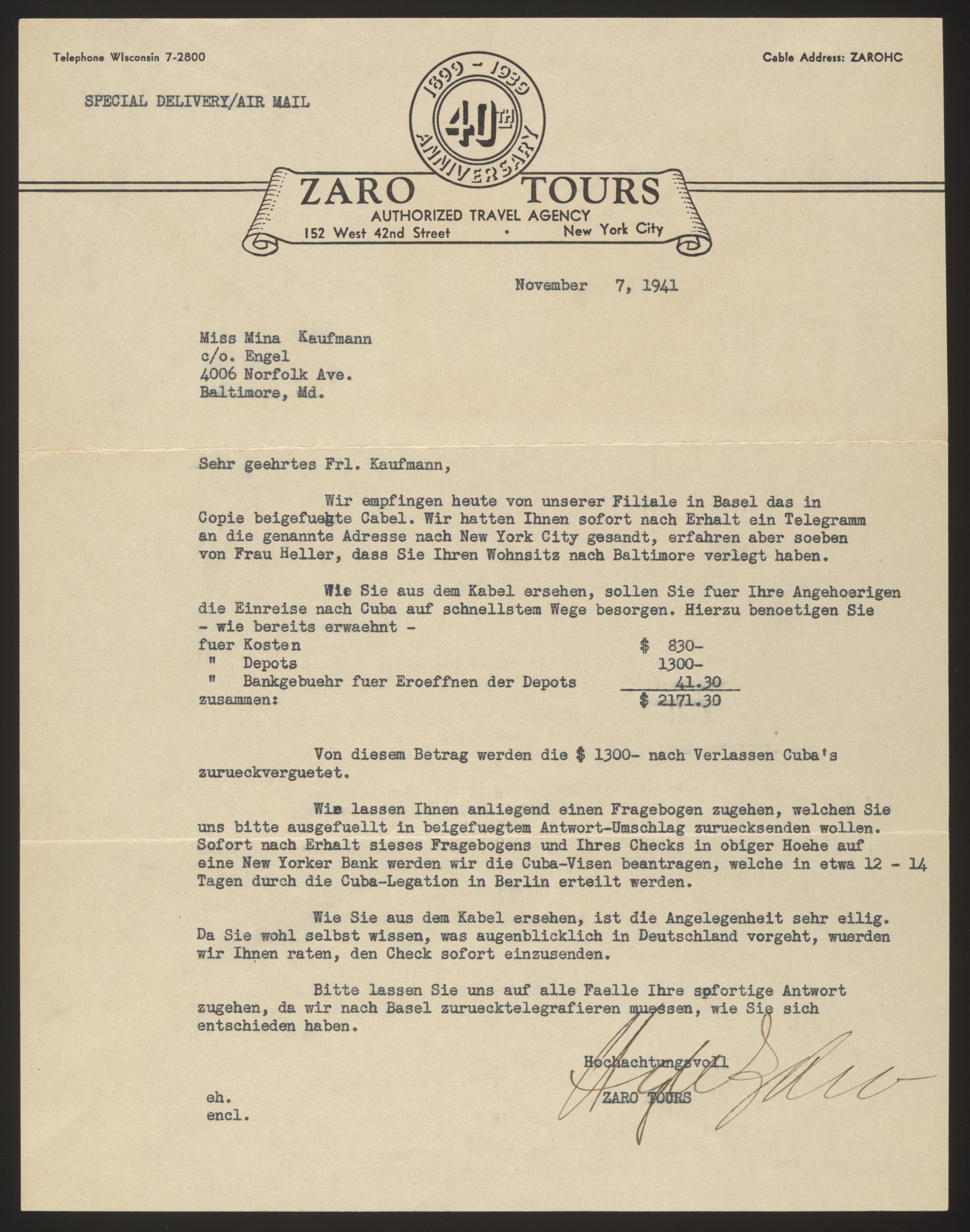
Typed letter from Zaro Tours to Mina Kaufmann, in German, regarding Cuba visa...
07.11.1941
Transcribed
Telephone Wisconsin 7-2800 Cable Address: ZAROHC
SPECIAL DELIVERY / AIR MAIL
ZARO TOURS
AUTHORIZED TRAVEL AGENCY
152 West 42nd Street • New York City
November 7, 1941
Miss Mina Kaufmann
c/o Engel
4006 Norfolk Ave.
Baltimore, Md.
Dear Miss Kaufmann,
Today we received from our Basel branch the cable enclosed in copy. Immediately
upon receipt we sent a telegram to the address given in New York City, but have just
learned from Mrs. Heller that you have moved your residence to Baltimore.
As you can see from the cable, you are to arrange entry to Cuba for your relatives
by the quickest route. For this you will need — as already mentioned —
for costs $ 830—
" deposits 1300—
" bank fee for opening the deposits 41.30
total: $ 2,171.30
Of this amount, the $1,300 will be refunded after leaving Cuba.
We are enclosing a questionnaire, which we ask you to fill out and return to us
in the enclosed reply envelope. Immediately upon receipt of this questionnaire and your
check in the above amount drawn on a New York bank, we will apply for the Cuba visas,
which will be issued in approximately 12–14 days through the Cuban Legation in Berlin.
As you can see from the cable, the matter is very urgent. Since you yourself
know what is currently happening in Germany, we would advise you to send the check
immediately.
Please send us your immediate reply in any case, as we must cable back to Basel
regarding your decision.
Respectfully,
ZARO TOURS
[Signature]
encl.
Telephone Wisconsin 7-2800 Cable Address: ZAROHC
SPECIAL DELIVERY / AIR MAIL
[40th Anniversary logo: 1899-1939]
ZARO TOURS
AUTHORIZED TRAVEL AGENCY
152 West 42nd Street • New York City
November 7, 1941
Miss Mina Kaufmann
c/o. Engel
4006 Norfolk Ave.
Baltimore, Md.
Sehr geehrtes Frl. Kaufmann,
Wir empfingen heute von unserer Filiale in Basel das in
Copie beigefuegte Cabel. Wir hatten Ihnen sofort nach Erhalt ein Telegramm
an die genannte Adresse nach New York City gesandt, erfahren aber soeben
von Frau Heller, dass Sie Ihren Wohnsitz nach Baltimore verlegt haben.
Wie Sie aus dem Kabel ersehen, sollen Sie fuer Ihre Angehoerigen
die Einreise nach Cuba auf schnellstem Wege besorgen. Hierzu benoetigen Sie
— wie bereits erwaehnt —
fuer Kosten $ 830—
" Depots 1300—
" Bankgebuehr fuer Eroeffnen der Depots 41.30
zusammen: $ 2171.30
Von diesem Betrag werden die $1300— nach Verlassen Cuba's
zurueckverguetet.
Wir lassen Ihnen anliegend einen Fragebogen zugehen, welchen Sie
uns bitte ausgefuellt in beigefuegtem Antwort-Umschlag zuruecksenden wollen.
Sofort nach Erhalt dieses Fragebogens und Ihres Checks in obiger Hoehe auf
eine New Yorker Bank werden wir die Cuba-Visen beantragen, welche in etwa 12 — 14
Tagen durch die Cuba-Legation in Berlin erteilt werden.
Wie Sie aus dem Kabel ersehen, ist die Angelegenheit sehr eilig.
Da Sie wohl selbst wissen, was augenblicklich in Deutschland vorgeht, wuerden
wir Ihnen raten, den Check sofort einzusenden.
Bitte lassen Sie uns auf alle Faelle Ihre sofortige Antwort
zugehen, da wir nach Basel zuruecktelegrafieren muessen, wie Sie sich
entschieden haben.
Hochachtungsvoll
eh. ZARO TOURS
encl. [Signature]
This letter represents the final, desperate attempt to rescue Julius and Elsa Oppenheimer. Zaro Tours — a well-known New York travel agency that specialized in helping refugees (founded 1899, celebrating its 40th anniversary on the letterhead) — relayed the urgent cable from their Basel, Switzerland branch. The plan was to obtain Cuban entry visas through the Cuban Legation in Berlin within 12-14 days, at a total cost of $2,171.30 (approximately $46,000 today). The $1,300 deposit was refundable upon leaving Cuba — a standard requirement to guarantee that refugees would not become permanent charges on the Cuban state. The chilling line "Since you yourself know what is currently happening in Germany" alludes to the escalating persecution without explicitly naming it — by November 1941, mass deportations of German Jews to eastern ghettos and killing sites had already begun. Mina Kaufmann had moved to Baltimore (c/o Engel, 4006 Norfolk Avenue), and the scramble to reach her — first a telegram to New York, then learning from Mrs. Heller about the move, then Special Delivery to Baltimore — underscores the frantic pace. The Cuba route via the Cuban Legation in Berlin was one of the last remaining escape paths, but it required an agonizing sequence: payment from New York to Zaro Tours, application through Berlin, visa issuance, and then actual departure from Germany — all within a rapidly closing window. The United States would enter the war exactly one month later.
Notes
Mentioned in Julius/Elsa 1940 shipping letter: 'a Mr. Jacob Kaufmann from Bayreuth will presumably bring the luggage or take it along'