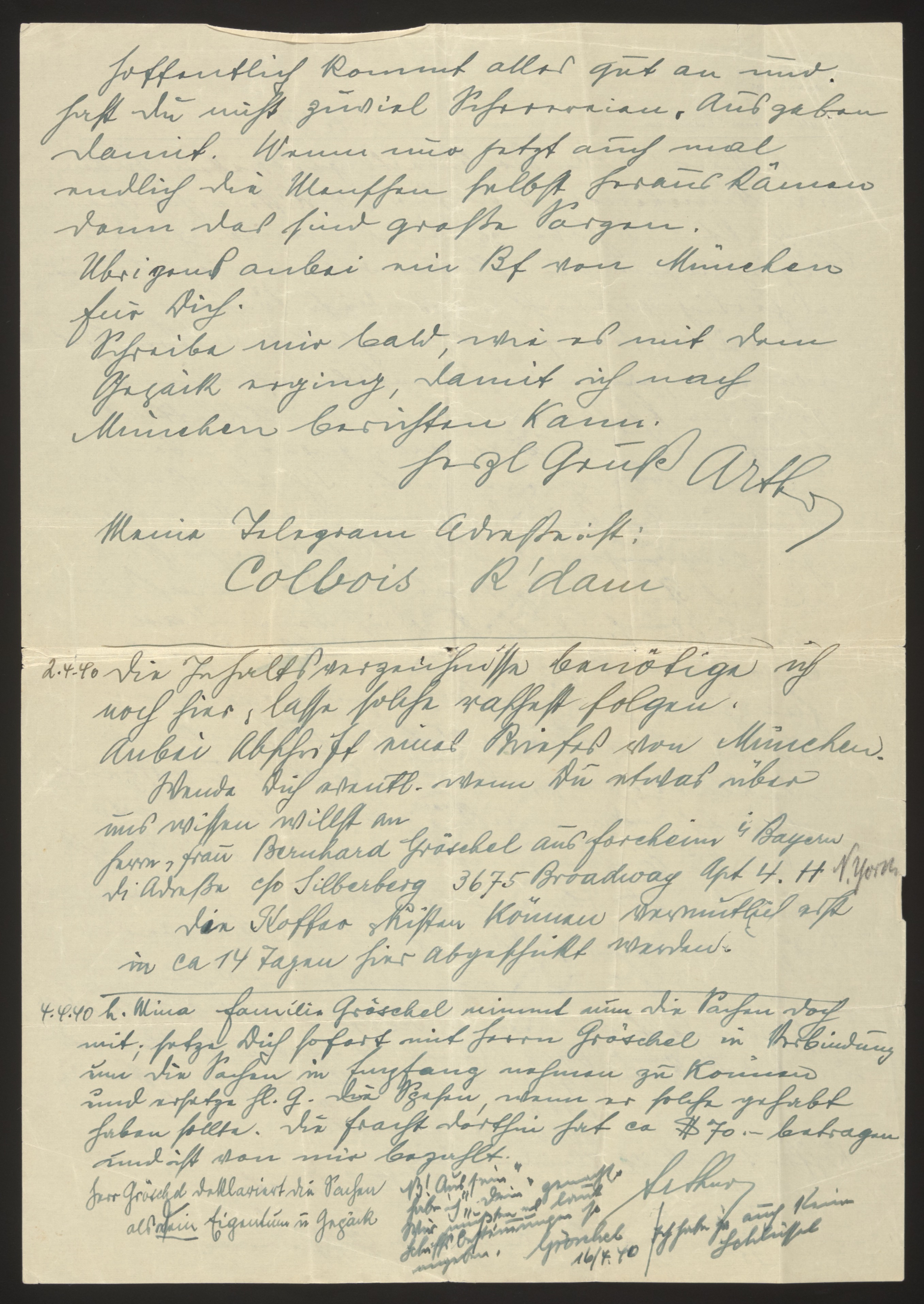
Letter:
[New York, USA]
(1939)→Letter:
New York, New York, USA
(1939)→Letter:
Rotterdam, Netherlands
(1940)→Letter:
Bronx, New York, USA
(1940)→Letter:
Brooklyn, New York, USA
(01.02.1941)→Letter:
New York, New York, USA
(04.02.1941)→Letter:
Bronx, New York, USA
(10.02.1941)→Letter:
Hannover, Germany
(08.10.1941)→Letter:
New York, New York, USA
(07.11.1941)
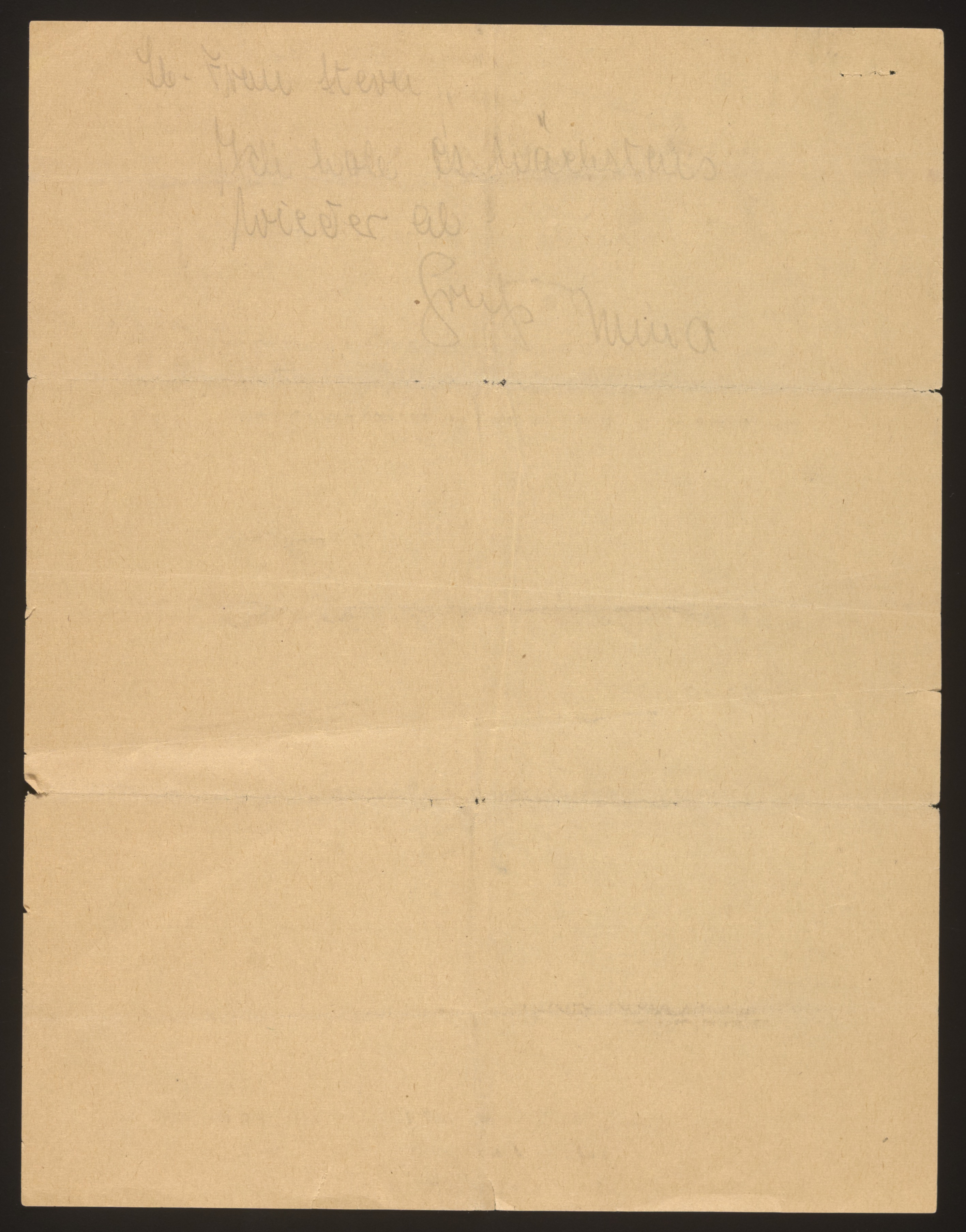
Correspondence (14 documents)
+8 more
Brief handwritten pencil note from Mina
1939
Transcribed
Dear Mrs. Steve!
Has [the devotional/religious matter?] [returned/come back] again!
Greetings, Mina
Lb. Frau Steve!
Hat sich Andächtiges [?]
wieder ab!
Grüße Mina
This brief, faint pencil note appears to be a quick personal message from Mina Kaufmann to a "Mrs. Steve" — likely a friend or neighbor. The note is largely illegible due to the light pencil writing and age of the document. It was preserved among the Oppenheimer immigration papers, suggesting it was jotted on the back of one of the documents being assembled for the visa application. The casual, abbreviated tone contrasts with the formal legal documents surrounding it, offering a glimpse of the everyday social interactions that continued alongside the urgent immigration work.
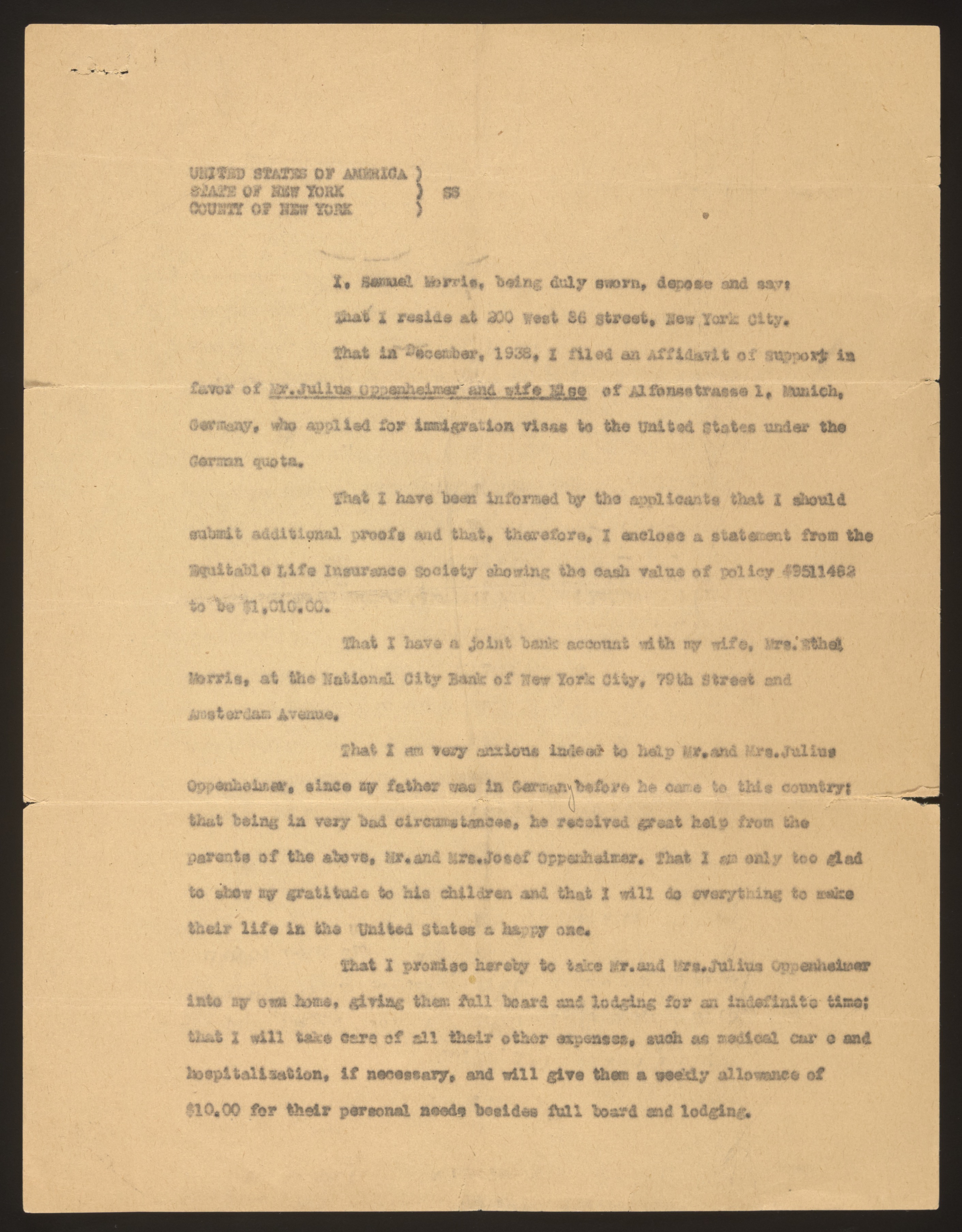
Typed updated affidavit of support from Samuel Morris (page 1 of 2)
1939
Transcribed
None
UNITED STATES OF AMERICA }
STATE OF NEW YORK } SS
COUNTY OF NEW YORK }
I, Samuel Morris, being duly sworn, depose and say:
That I reside at 200 West 86 Street, New York City.
That in December, 1938, I filed an affidavit of support in
favor of Mr. Julius Oppenheimer and wife Mrs. of Alfonsstrasse 1, Munich,
Germany, who applied for immigration visas to the United States under the
German quota.
That I have been informed by the applicants that I should
submit additional proofs and that, therefore, I enclose a statement from the
Equitable Life Insurance Society showing the cash value of policy #551462
to be $1,016.00.
That I have a joint bank account with my wife, Mrs. Ethel
Morris, at the National City Bank of New York City, 79th Street and
Amsterdam Avenue.
That I am very anxious indeed to help Mr. and Mrs. Julius
Oppenheimer, since my father was in Germany before he came to this country;
that being in very bad circumstances, he received great help from the
parents of the above, Mr. and Mrs. Josef Oppenheimer. That I am only too glad
to show my gratitude to his children and that I will do everything to make
their life in the United States a happy one.
That I promise hereby to take Mr. and Mrs. Julius Oppenheimer
into my own home, giving them full board and lodging for an indefinite time;
that I will take care of all their other expenses, such as medical care and
hospitalization, if necessary, and will give them a weekly allowance of
$10.00 for their personal needs besides full board and lodging.
This updated affidavit from Samuel Morris expands significantly on his earlier letters (0003/0005) and provides crucial genealogical information. Morris reveals that his father had been helped by "Mr. and Mrs. Josef Oppenheimer" — Julius's parents — when the elder Morris was in dire circumstances in Germany. This confirms that the Oppenheimer family's reputation for generosity extended back at least one generation, to Josef Oppenheimer (Julius's father, b. ~1860s in Gemmingen). Morris's gratitude is deeply personal and intergenerational: the Oppenheimers helped his father, and now he wishes to repay that debt by rescuing their son and daughter-in-law. His financial documentation includes an Equitable Life Insurance policy (#551462) worth $1,016 and a joint bank account with his wife Ethel Morris at the National City Bank (79th and Amsterdam — the same bank branch used by Mina Kaufmann in 0011). His promise of full board, lodging, medical care, hospitalization, and $10/week ($215/week today) represents the most comprehensive support package offered by any sponsor.
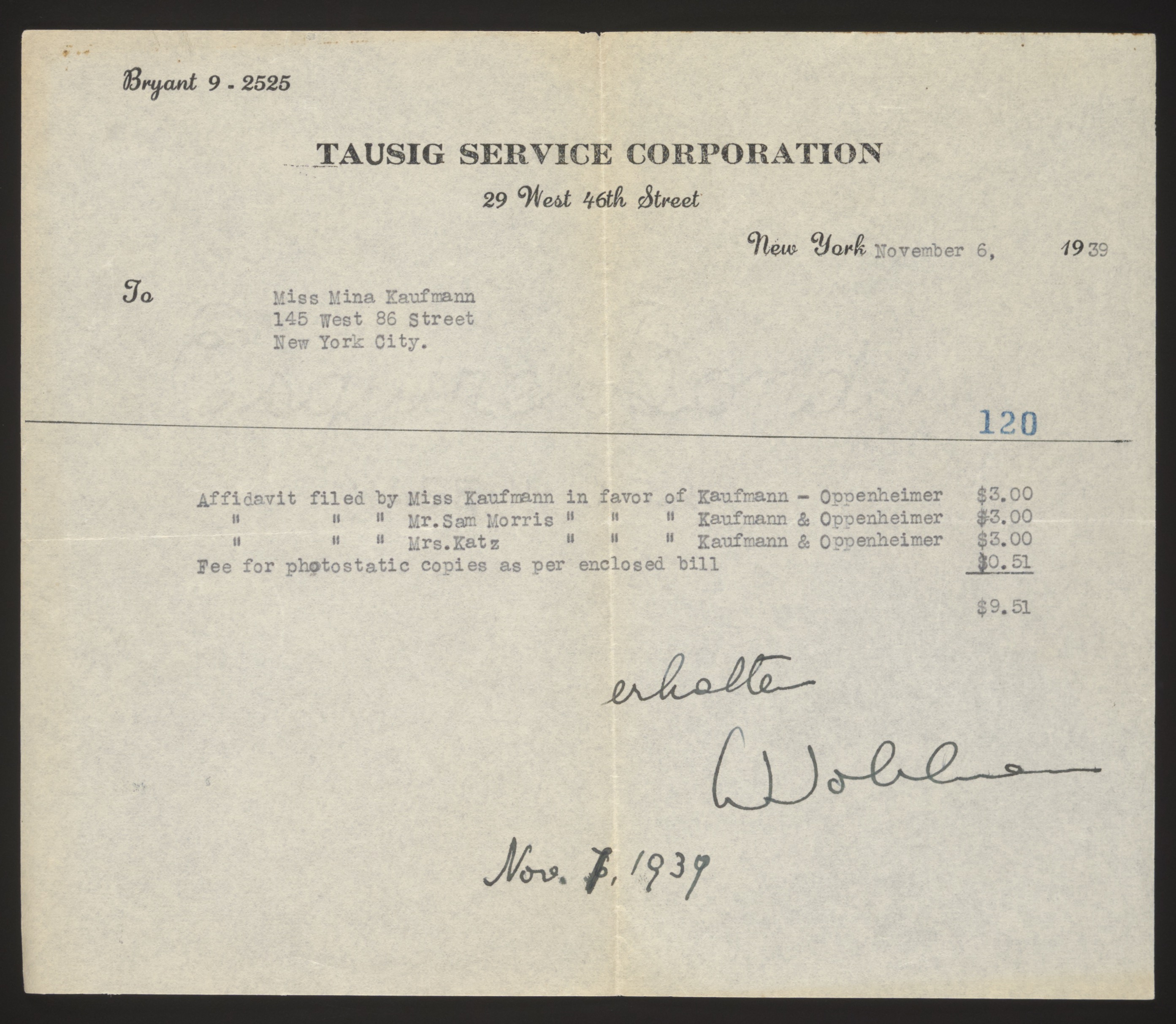
Invoice from Tausig Service Corporation for affidavit filing fees
06.11.1939
Transcribed
This is an invoice from the Tausig Service Corporation, a service agency at 29 West 46th Street, New York, billing Miss Mina Kaufmann at 145 West 86th Street, New York City, for the filing of three affidavits of support in favor of the Kaufmann-Oppenheimer family. The affidavits were filed by Mina Kaufmann, Samuel Morris, and Mrs. Ketz, each costing $3.00. An additional $0.51 was charged for photostatic copies, for a total of $9.51. A handwritten notation "erhalten" (German for "received") with a signature and the date November 7, 1939 confirms payment.
Bryant 9-2525
TAUSIG SERVICE CORPORATION
29 West 46th Street
New York November 6, 1939
To Miss Mina Kaufmann
145 West 86 Street
New York City.
120
Affidavit filed by Miss Kaufmann in favor of Kaufmann – Oppenheimer $3.00
" " " Mr. Sam Morris " " Kaufmann & Oppenheimer $3.00
" " " Mrs. Ketz " " Kaufmann & Oppenheimer $3.00
Fee for photostatic copies as per enclosed bill $0.51
-----
$9.51
erhalten [received]
[Signature: Wohl…]
Nov. 7, 1939
This invoice documents the immigration sponsorship efforts on behalf of Julius and Elsa Oppenheimer. In 1939, Jewish refugees fleeing Nazi Germany needed American sponsors to file affidavits of support — sworn statements guaranteeing financial responsibility — in order to obtain immigration visas. Mina Kaufmann (née Weiler), a cousin already in New York, coordinated multiple affidavits through the Tausig Service Corporation, a firm that assisted refugees with immigration paperwork. Three separate sponsors — Mina herself, Samuel Morris, and a Mrs. Ketz — each filed affidavits. The total cost of $9.51 (approximately $200 in today's money) underscores the bureaucratic expenses involved in the emigration process. The German notation "erhalten" on an American business invoice reflects the bilingual world of German-Jewish refugees in New York.
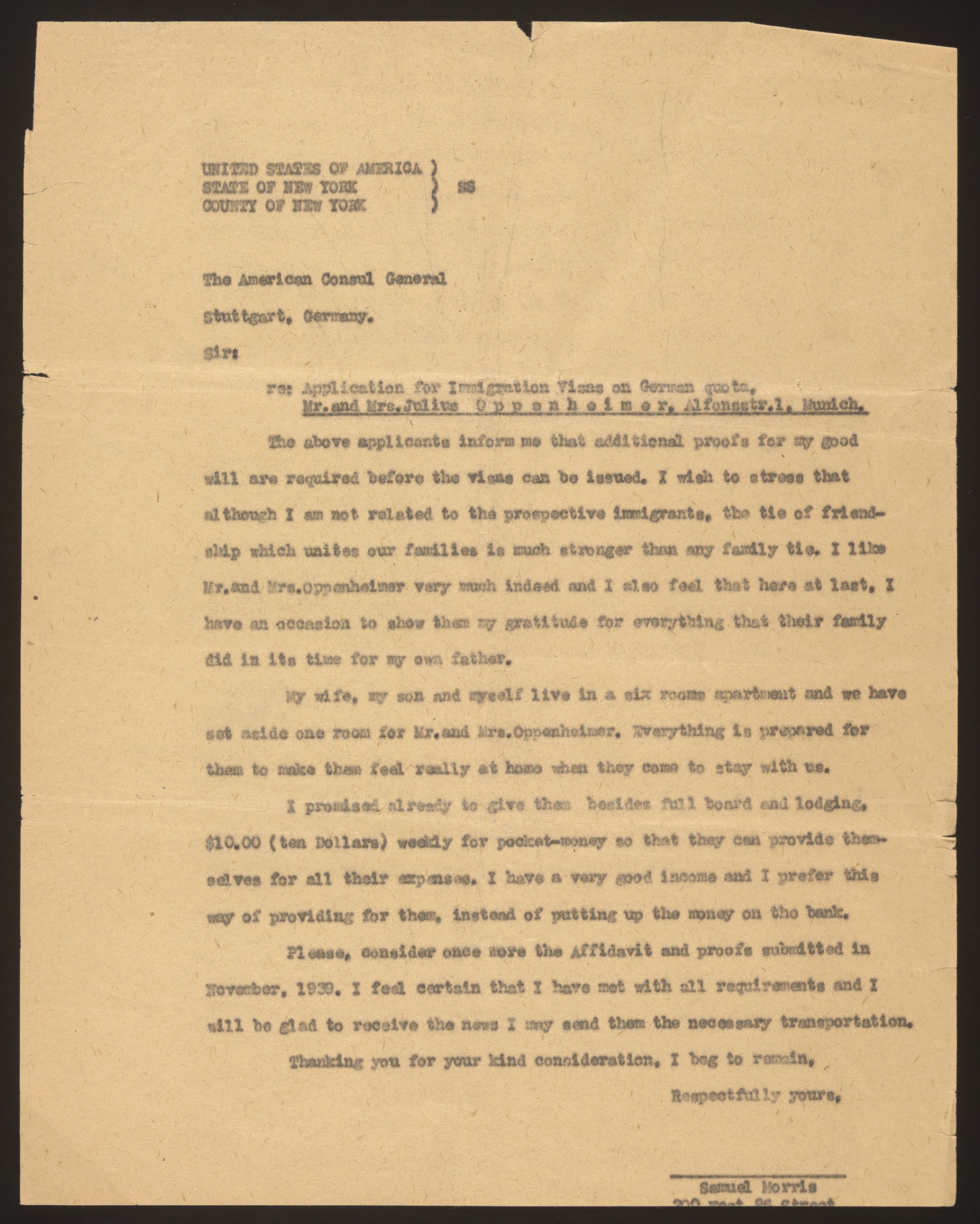
Typed letter / affidavit of support from Samuel Morris to the American Consul...
11.1939
Transcribed
None
UNITED STATES OF AMERICA }
STATE OF NEW YORK } SS
COUNTY OF NEW YORK }
The American Consul General
Stuttgart, Germany.
Sir:
re: Application for Immigration Visas on German quota,
Mr. and Mrs. Julius Oppenheimer, Alfonsstr.1, Munich.
The above applicants inform me that additional proofs for my good
will are required before the visas can be issued. I wish to stress that
although I am not related to the prospective immigrants, the tie of friend-
ship which unites our families is much stronger than any family tie. I like
Mr. and Mrs. Oppenheimer very much indeed and I also feel that here at last, I
have an occasion to show them my gratitude for everything that their family
did in its time for my own father.
My wife, my son and myself live in a six rooms apartment and we have
set aside one room for Mr. and Mrs. Oppenheimer. Everything is prepared for
them to make them feel really at home when they come to stay with us.
I promised already to give them besides full board and lodging,
$10.00 (ten Dollars) weekly for pocket-money so that they can provide them-
selves for all their expenses. I have a very good income and I prefer this
way of providing for them, instead of putting up the money on the bank.
Please, consider once more the Affidavit and proofs submitted in
November, 1939. I feel certain that I have met with all requirements and I
will be glad to receive the news I may send them the necessary transportation.
Thanking you for your kind consideration, I beg to remain,
Respectfully yours,
Samuel Morris
200 West 86 Street [partially visible]
This is a powerful letter from Samuel Morris, a New York resident, to the American Consul General in Stuttgart, supplementing his affidavit of support for Julius and Elsa Oppenheimer's immigration visa application. Morris emphasizes that while not a blood relative, the bond between the families is "much stronger than any family tie" — the Oppenheimer family had helped his own father in the past, and he now wishes to repay that debt. He details concrete plans: a room set aside in his six-room apartment, full board and lodging, and $10 per week in pocket money (about $215/week today). His address at 200 West 86th Street places him in the same Upper West Side neighborhood as Mina Kaufmann (145 West 86th Street), suggesting a close-knit community of German-Jewish immigrants coordinating rescue efforts. The Oppenheimers were living at Alfonsstrasse 1, Munich, at the time of this application. The letter's urgent, personal tone — and its reference to proofs "submitted in November, 1939" — reflects the increasingly desperate race against time as war had already broken out in Europe.
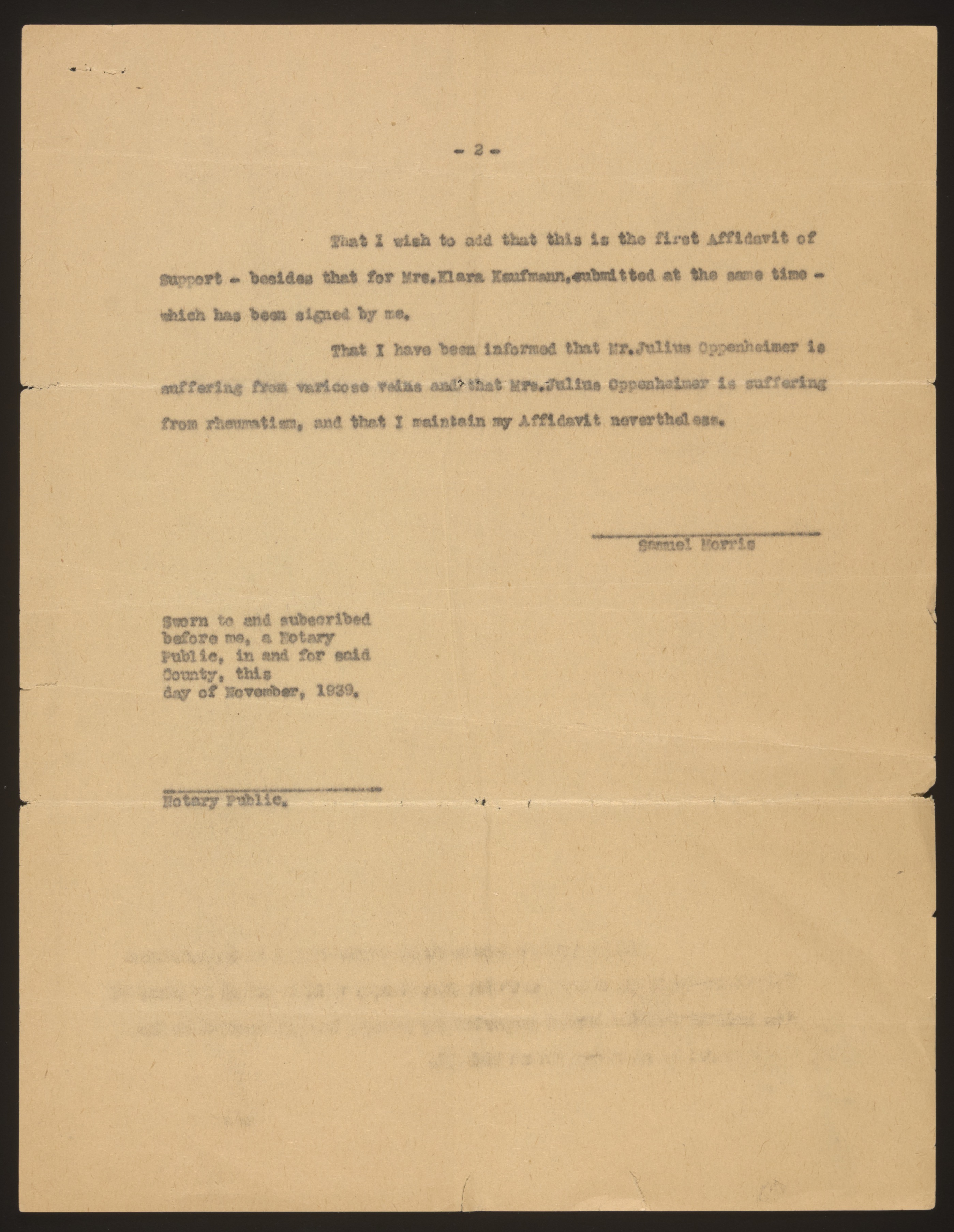
Typed affidavit of support from Samuel Morris (page 2 of 2), with notary jurat
11.1939
Transcribed
None
- 2 -
That I wish to add that this is the first Affidavit of
support — besides that for Mrs. Klara Kaufmann, submitted at the same time —
which has been signed by me.
That I have been informed that Mr. Julius Oppenheimer is
suffering from varicose veins and that Mrs. Julius Oppenheimer is suffering
from rheumatism, and that I maintain my Affidavit nevertheless.
________________________
Samuel Morris
Sworn to and subscribed
before me, a Notary
Public, in and for said
County, this
day of November, 1939.
________________________
Notary Public.
This second page of Samuel Morris's affidavit contains two significant statements. First, he declares that this is his first affidavit of support (apart from one simultaneously filed for Mrs. Klara Kaufmann), addressing the consulate's concern about sponsors overextending themselves with multiple guarantees. Second, and more poignantly, he acknowledges being informed of the Oppenheimers' health conditions — Julius suffering from varicose veins and Elsa from rheumatism — and explicitly states he maintains his sponsorship "nevertheless." This was a critical declaration: U.S. consulates routinely denied visas to immigrants with health conditions, fearing they would become public charges. By acknowledging the conditions and reaffirming his commitment, Morris was directly countering a common ground for visa refusal. The mention of Klara Kaufmann receiving a parallel affidavit connects to the broader family rescue network visible across this correspondence folder.
Handwritten letter from Arthur Baer to Mina Kaufmann (page 2 of 2)
1940
Transcribed
hopefully everything arrives safely and
doesn't cost you too much in repairs. Never mind
about that. If we could now finally
get the people themselves out,
those are the great worries.
By the way, enclosed is a letter from Munich
for you.
Write to me soon about how the
application went, so that I can report
back to Munich.
Warm greetings, Arth[ur].
My telegram address:
Colbois R'dam
April 2, 1940: The inventory lists concerning [the shipment] are
still pending, I'll send them along quickly.
Enclosed is a copy of a letter from Munich.
If you want to know something about
us, contact
Mr. and Mrs. Bernhard Gröschel from Forchheim in Bavaria,
address: c/o Silberberg, 3675 Broadway, Apt. 4. H., New York.
The suitcases/crates can probably only be
dispatched from here in about 14 days.
April 4, 1940: Dear Mina, the Gröschel family is now taking the things there
with them. Get in touch with Mr. Gröschel immediately
in order to be able to receive the things,
specifically [regarding] the papers, if such have been issued [?].
The freight there cost approximately $70 —
and has been paid by me.
Mr. Gröschel declares the things [as his property]
as his own property and contents.
[Additional annotations with dates and signatures]
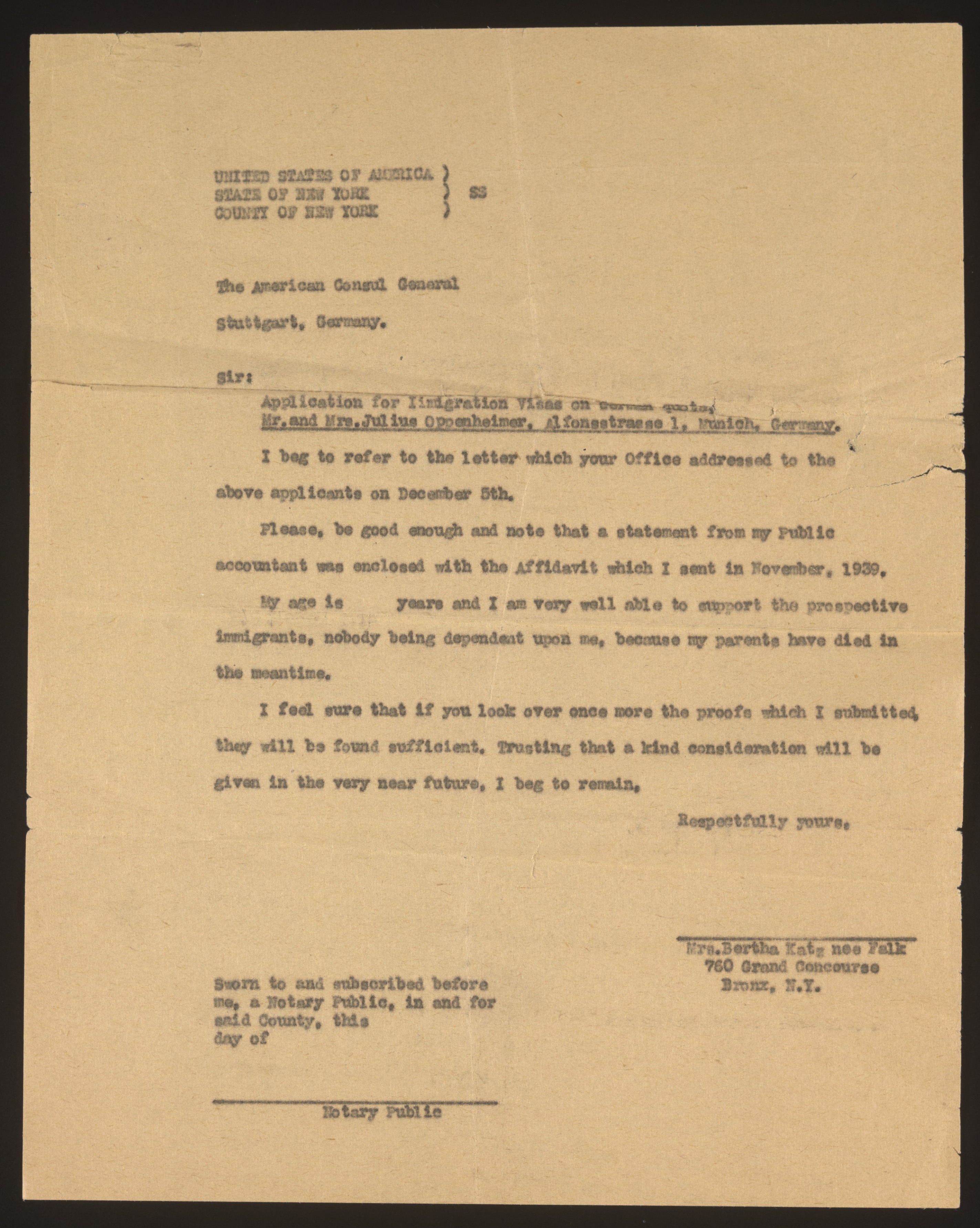
hoffentlich kommt alles gut an und
geht du nicht zu viel Reparaturen. Auf geben
damit. Wenn wir jetzt auf mal
endlich die Menschen selbst heraus bekämen
dann das sind große Sorgen.
Übrigens anbei ein Bf. von München
für Dich.
Schreibe mir bald, wie es mit dem
Gesuch erging, damit ich nach
München berichten kann.
Hrzl Grüße Arth.
Meine Telegramm Adresse:
Colbois R'dam
2.4.40 Die Inhaltsverzeichnisse betreffend ist
noch frei, lasse solche rasch folgen.
Anbei Abschrift eines Briefes von München.
Wende Dich event. wann du etwas über
uns wissen willst an
Herrn, Frau Bernhard Gröschel aus Forchheim i. Bayern
die Adr. c/o Silberberg 3675 Broadway Apt. 4. H. N. York.
Die Koffer/Kisten können vermutlich erst
in ca 14 Tagen hier abgefertigt werden.
4.4.40 L. Mina Familie Gröschel nimmt nun die Sachen dort
mit, setze Dich sofort mit Herrn Gröschel in Verbindung
um die Sachen in Empfang nehmen zu können
und zwar K.G. [?] die Papiere, wann so solche gesetzt [?]
haben sollte. Die Fracht dorthin hat ca $70.— betragen
und ist von mir bezahlt.
Herr Gröschel deklariert die Sachen [several annotations and signatures]
als sein Eigentum u. Inhalt
[Additional handwritten annotations with dates and signatures, partially illegible]
This continuation letter, with its cascading postscript entries over several days (April 1, 2, and 4, 1940), captures the rapidly evolving logistics of the Oppenheimer property shipment. Arthur Baer's emotional aside — "If we could now finally get the people themselves out, those are the great worries" — reveals that while possessions could be shipped, the people themselves were still trapped. The plan evolved: rather than using the Holland America Line freight service alone, the Gröschel family (Bernhard Gröschel from Forchheim, Bavaria, now c/o Silberberg at 3675 Broadway, New York) would personally accompany the crates and suitcases, declaring them as their own property to avoid customs complications. The freight cost of $70 (about $1,500 today) was paid by Baer himself. His telegram address "Colbois R'dam" (Rotterdam) and the 14-day shipping estimate place this firmly in the final window before the German invasion of the Netherlands on May 10, 1940. The Gröschels were themselves recent refugees from Forchheim in Bavaria, now part of the broader network of German-Jewish émigrés helping each other from New York.
Typed letter/affidavit from Mrs. Bertha Katz née Falk to the American Consul ...
1940
Transcribed
None
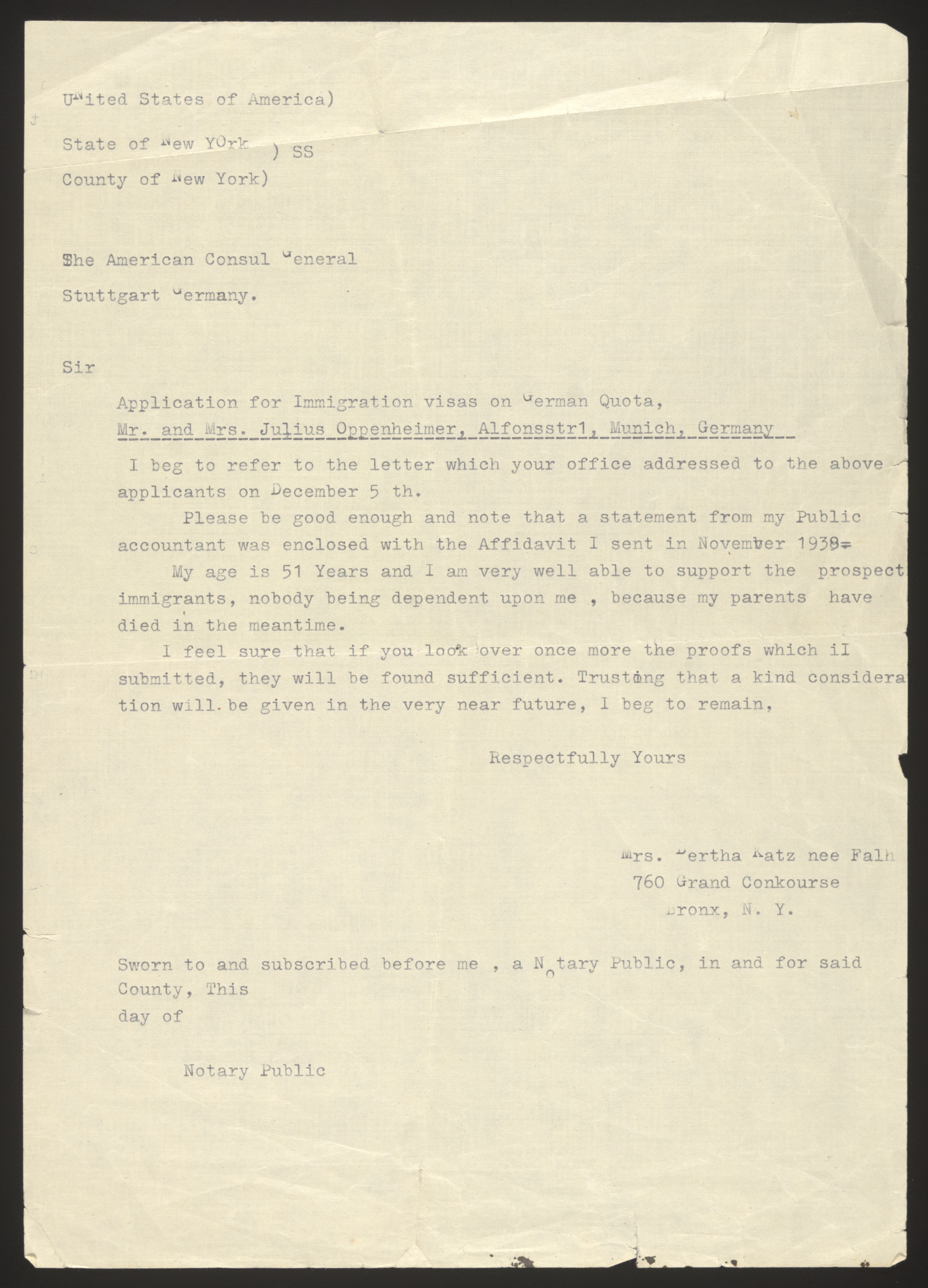
UNITED STATES OF AMERICA }
STATE OF NEW YORK } SS
COUNTY OF NEW YORK }
The American Consul General
Stuttgart, Germany.
Sir:
Application for Immigration Visas on German quota,
Mr. and Mrs. Julius Oppenheimer, Alfonsstrasse 1, Munich, Germany.
I beg to refer to the letter which your Office addressed to the
above applicants on December 5th.
Please, be good enough and note that a statement from my Public
accountant was enclosed with the Affidavit which I sent in November, 1939.
My age is [blank] years and I am very well able to support the prospective
immigrants, nobody being dependent upon me, because my parents have died in
the meantime.
I feel sure that if you look over once more the proofs which I submitted,
they will be found sufficient. Trusting that a kind consideration will be
given in the very near future, I beg to remain,
Respectfully yours,
Mrs. Bertha Katz nee Falk
760 Grand Concourse
Bronx, N.Y.
Sworn to and subscribed before
me, a Notary Public, in and for
said County, this
day of
________________________
Notary Public
This letter from Mrs. Bertha Katz (née Falk) of 760 Grand Concourse in the Bronx is a follow-up to her November 1939 affidavit of support. She references a letter from the Stuttgart consulate to the Oppenheimers dated December 5th, suggesting the consulate had raised questions about the sufficiency of her financial documentation. She reminds the consul that her public accountant's statement was already included and notes that she has no dependents since her parents have "died in the meantime" — a poignant detail that may refer to their deaths in Germany. Her age was left blank in this version (filled in as 51 in the retyped copy, 0023). Mrs. Katz is almost certainly the "Mrs. Ketz" listed on the Tausig Service Corporation invoice (0001), with the slight spelling variation typical of the period. Her address on the Grand Concourse — the prestigious main boulevard of the Bronx — and her use of a public accountant suggest financial stability. This letter represents yet another sponsor adding to the mounting paperwork in the Oppenheimers' visa file.
Retyped clean copy of Mrs. Bertha Katz née Falk's letter to the American Cons...
1940
Transcribed
None
United States of America)
State of New York ) SS
County of New York)
The American Consul General
Stuttgart, Germany.
Sir
Application for Immigration visas on German Quota,
Mr. and Mrs. Julius Oppenheimer, Alfonsstr1, Munich, Germany
I beg to refer to the letter which your office addressed to the above
applicants on December 5 th.
Please be good enough and note that a statement from my Public
accountant was enclosed with the Affidavit I sent in November 1938=
My age is 51 Years and I am very well able to support the prospect
immigrants, nobody being dependent upon me, because my parents have
died in the meantime.
I feel sure that if you look over once more the proofs which I[f]
submitted, they will be found sufficient. Trusting that a kind considera
tion will be given in the very near future, I beg to remain,
Respectfully Yours
Mrs. Bertha Katz nee Faln [Falk]
760 Grand Concourse
Bronx, N. Y.
Sworn to and subscribed before me, a Notary Public, in and for said
County, This
day of
Notary Public
This is a retyped clean copy of the letter in 0022, likely prepared for a second submission or for the sponsor's own records. The key difference is that her age is now given as 51 years (left blank in the original). There is also a minor discrepancy: this copy references "November 1938" rather than "November 1939" for the date of the original affidavit — likely a typographical error, as the Tausig Service Corporation invoice (0001) dates the affidavit filings to November 1939. The existence of two versions of the same letter reflects the meticulous documentation that sponsors maintained, knowing that any deficiency could delay or prevent the issuance of life-saving visas.
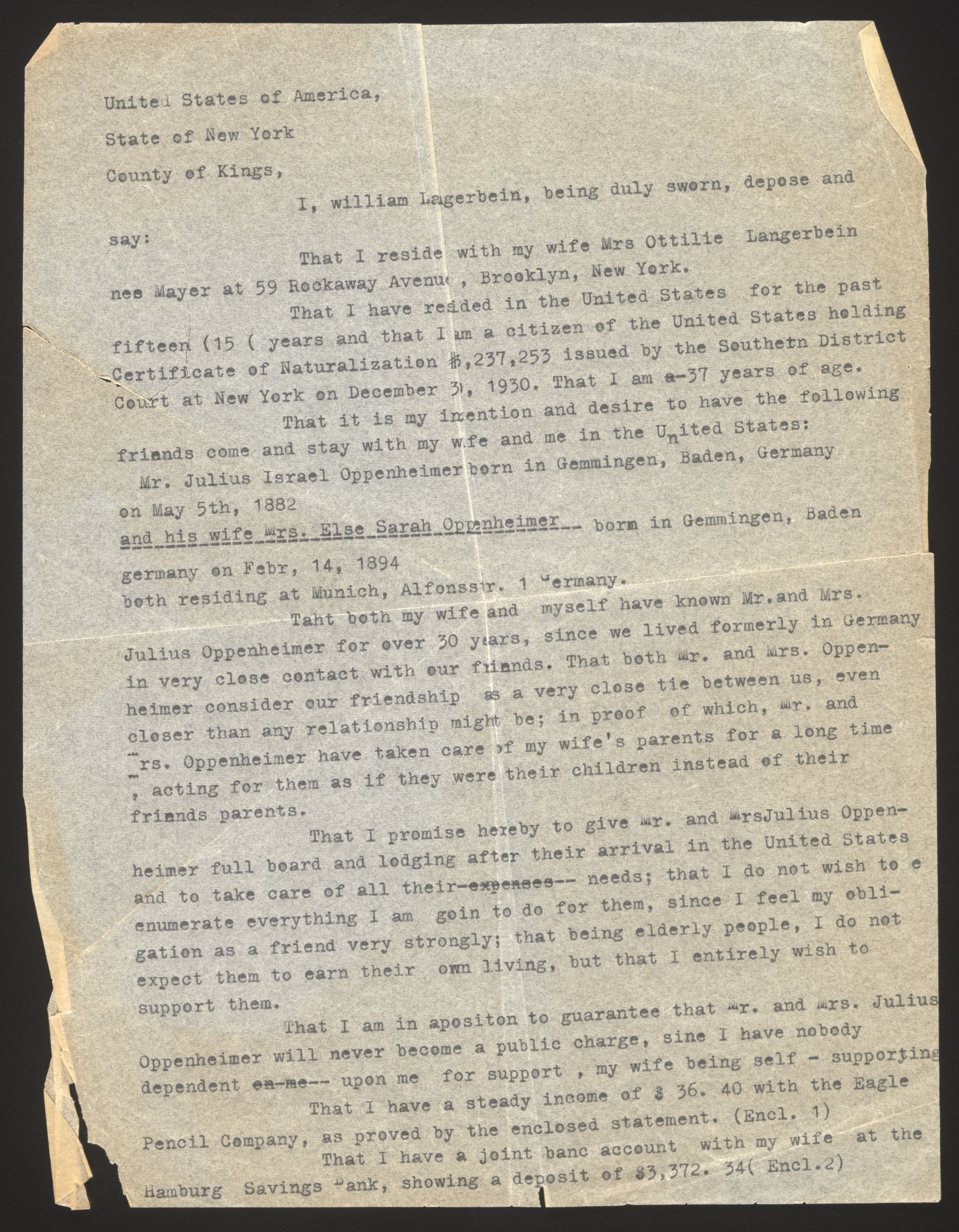
Typed affidavit of support from William Langerbein to the American Consul Gen...
01.02.1941
Transcribed
None
United States of America,
State of New York
County of Kings,
I, William Langerbein, being duly sworn, depose and
say:
That I reside with my wife Mrs. Ottilie Langerbein
nee Mayer at 59 Rockaway Avenue, Brooklyn, New York.
That I have resided in the United States for the past
fifteen (15) years and that I am a citizen of the United States holding
Certificate of Naturalization #.237,253 issued by the Southern District
Court at New York on December 3, 1930. That I am a—37 years of age.
That it is my intention and desire to have the following
friends come and stay with my wife and me in the United States:
Mr. Julius Israel Oppenheimer born in Gemmingen, Baden, Germany
on May 5th, 1882
and his wife Mrs. Elsa Sarah Oppenheimer — born in Gemmingen, Baden,
Germany on Febr. 14, 1894
both residing at Munich, Alfonsstr. 1 Germany.
That both my wife and myself have known Mr. and Mrs.
Julius Oppenheimer for over 30 years, since we lived formerly in Germany
in very close contact with our friends. That both Mr. and Mrs. Oppen-
heimer consider our friendship as a very close tie between us, even
closer than any relationship might be; in proof of which, Mr. and
Mrs. Oppenheimer have taken care of my wife's parents for a long time
, acting for them as if they were their children instead of their
friends parents.
That I promise hereby to give Mr. and Mrs.Julius Oppen-
heimer full board and lodging after their arrival in the United States,
and to take care of all their expenses — needs; that I do not wish to
enumerate everything I am going to do for them, since I feel my obli-
gation as a friend very strongly; that being elderly people, I do not
expect them to earn their own living, but that I entirely wish to
support them.
That I am in a position to guarantee that Mr. and Mrs. Julius
Oppenheimer will never become a public charge, since I have nobody
dependent on me— upon me for support, my wife being self — supporting.
That I have a steady income of $36.40 with the Eagle
Pencil Company, as proved by the enclosed statement. (Encl. 1)
That I have a joint bank account with my wife at the
Hamburg Savings —ank, showing a deposit of $3,172.24 (Encl.2)
This affidavit from William Langerbein of Brooklyn is one of the most detailed sponsorship documents in the collection. Langerbein, a naturalized U.S. citizen since 1930 (15 years in the country, age 37), provides key biographical data for both Julius and Elsa Oppenheimer: Julius born May 5, 1882, and Elsa born February 14, 1894, both in Gemmingen, Baden — confirming their birthplace and the 12-year age difference between them. Their Munich address at Alfonsstrasse 1 is consistent with the earlier documents. Langerbein's emotional language — that the friendship was "closer than any relationship" and that the Oppenheimers had "taken care of my wife's parents for a long time, acting for them as if they were their children" — reflects genuine personal obligation. His financial resources included employment at the Eagle Pencil Company ($36.40/week, roughly $40,000/year in today's money) and savings of $3,172.24 at the Hamburg Savings Bank. The document is dated February 1, 1941, over a year after the initial affidavits of November 1939, indicating that the visa process was still unresolved despite multiple sponsors and extensive documentation.
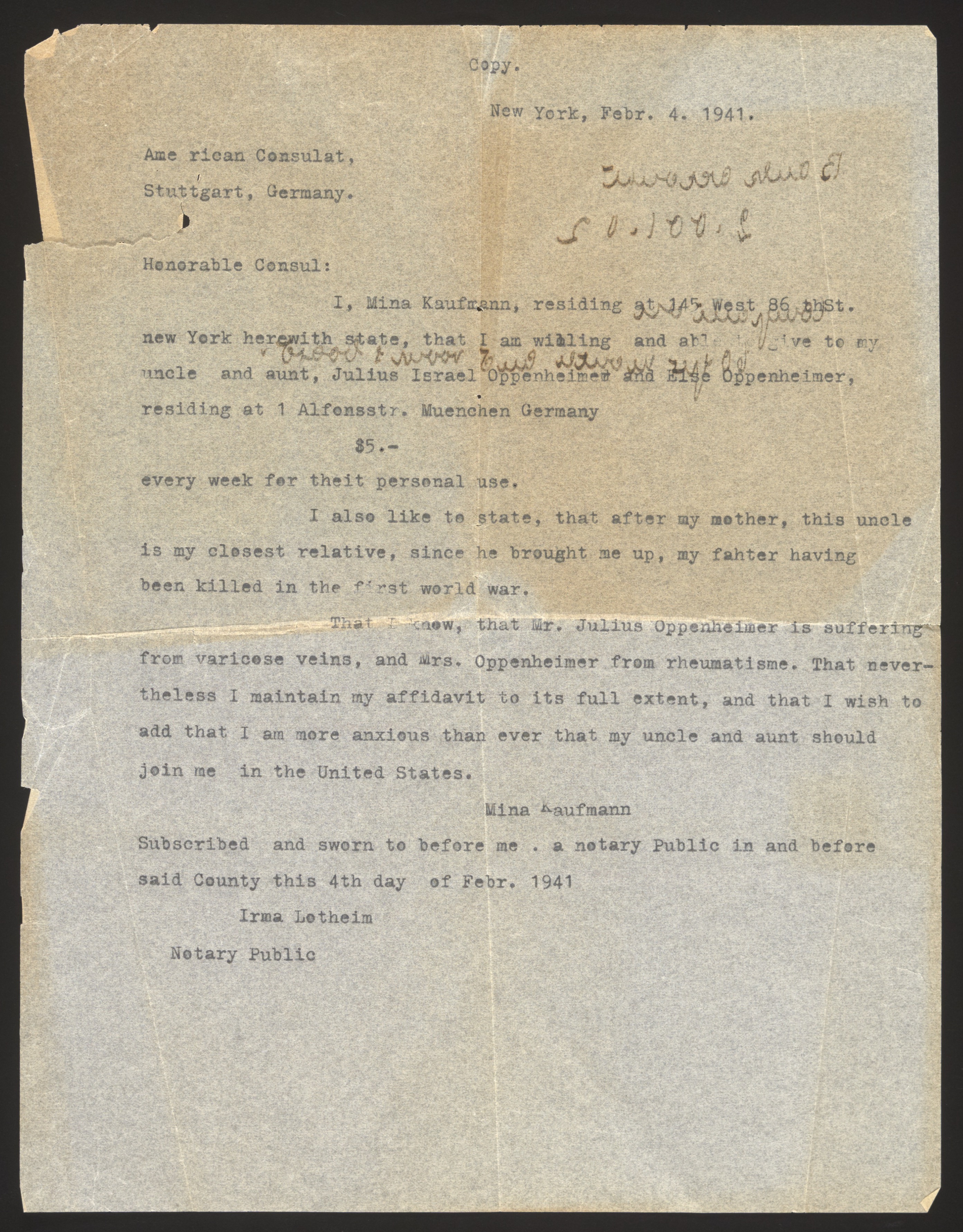
Typed letter/affidavit from Mina Kaufmann to the American Consulate in Stuttg...
04.02.1941
Transcribed
None
Copy.
New York, Febr. 4. 1941.
Ame rican Consulat,
Stuttgart, Germany. [Handwritten annotations: illegible]
Honorable Consul:
I, Mina Kaufmann, residing at 145 West 86 Str.
new York herewith state, that I am willing and abl[e] [to gi]ve to my
uncle and aunt, Julius Israel Oppenheimer and Elsa Oppenheimer,
residing at 1 Alfonsstr. Muenchen Germany
$5.—
every week for their personal use.
I also like to state, that after my mother, this uncle
is my closest relative, since he brought me up, my father having
been killed in the first world war.
That I know, that Mr. Julius Oppenheimer is suffering
from varicose veins, and Mrs. Oppenheimer from rheumatism. That never-
theless I maintain my affidavit to its full extent, and that I wish to
add that I am more anxious than ever that my uncle and aunt should
join me in the United States.
Mina Kaufmann
Subscribed and sworn to before me, a notary Public in and before
said County this 4th day of Febr. 1941
Irma Lotheim
Notary Public
This is perhaps the most personal document in the entire collection. Mina Kaufmann — the central figure coordinating the rescue effort from New York — reveals her own family connection: Julius Oppenheimer is her uncle and closest living relative after her mother. She explains that Julius "brought me up" because her father was killed in the First World War. This biographical detail transforms our understanding of the entire correspondence: Mina's tireless efforts — coordinating multiple sponsors, depositing $1,015 at the bank, paying for affidavit filings, arranging luggage storage — were driven not just by family obligation but by a deep personal debt to the uncle who raised her after she was orphaned by war. Her promise of $5 per week (about $107/week today) for personal expenses supplemented the full board and lodging promised by the Langerbeins and Samuel Morris. Like Morris and Langerbein before her, she explicitly acknowledges the Oppenheimers' health conditions (varicose veins and rheumatism) and maintains her affidavit "nevertheless" — the same formula used to counter the consulate's potential objection to admitting immigrants with medical conditions. The document is dated February 4, 1941 — three days after the Langerbein affidavit — suggesting a coordinated blitz of paperwork aimed at finally securing the visas. Notarized by Irma Lotheim.
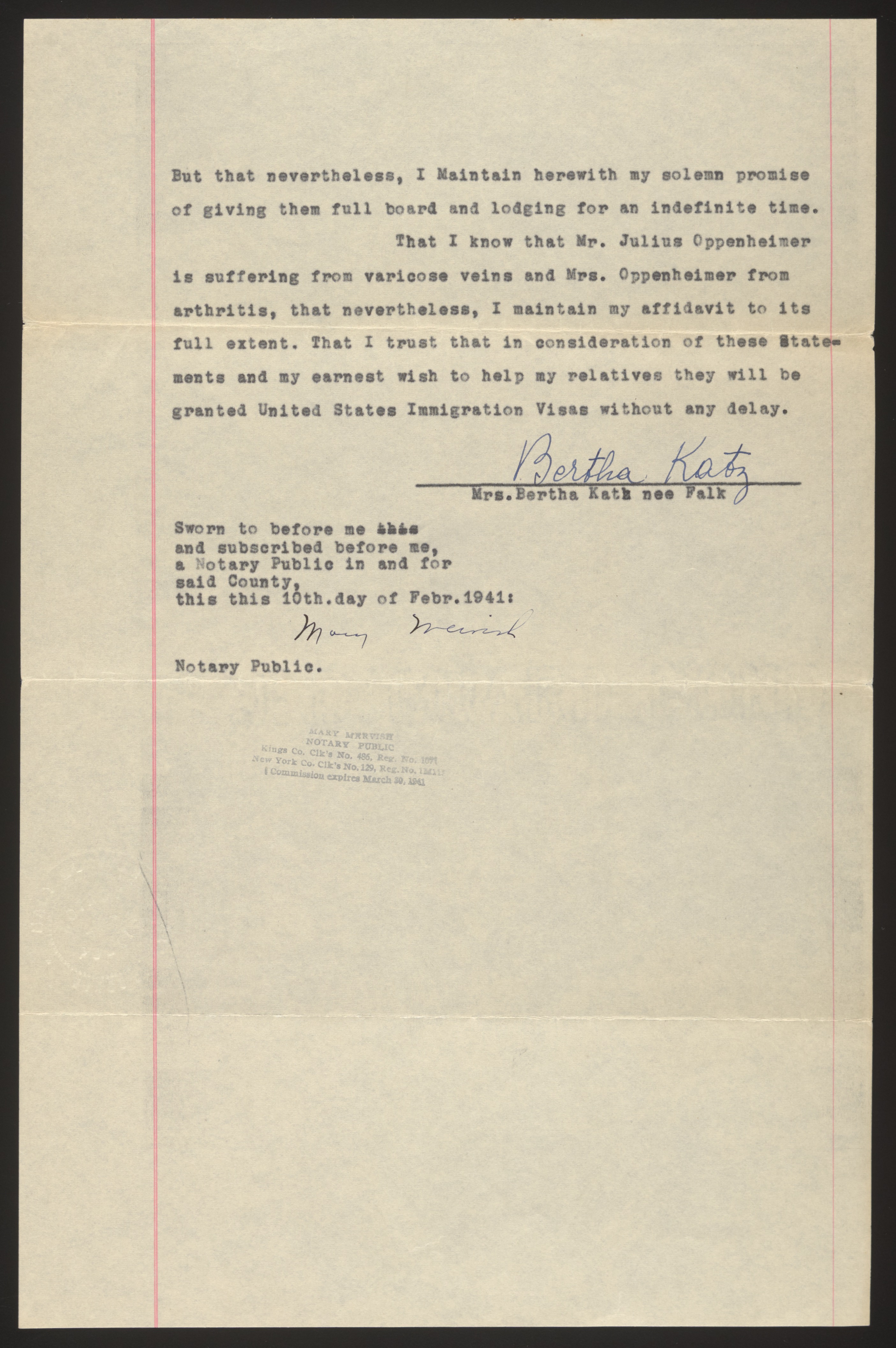
Typed formal affidavit of support from Mrs. Bertha Katz née Falk (page 2 of 2)
10.02.1941
Transcribed
None
But that nevertheless, I Maintain herewith my solemn promise
of giving them full board and lodging for an indefinite time.
That I know that Mr. Julius Oppenheimer
is suffering from varicose veins and Mrs. Oppenheimer from
arthritis, that nevertheless, I maintain my affidavit to its
full extent. That I trust that in consideration of these State-
ments and my earnest wish to help my relatives they will be
granted United States Immigration Visas without any delay.
Bertha Katz
Mrs. Bertha Katz nee Falk
Sworn to before me and
and subscribed before me,
a Notary Public in and for
said County,
this this 10th.day of Febr.1941:
Mary Meurich
Notary Public.
[Notary stamp:]
MARY MEURICH
NOTARY PUBLIC
Kings Co. Clk's No. 88, Reg. No. 1097
New York Co. Clk's No. 139, Reg. No. 1M117
Commission expires March 30, 1941
The conclusion of Bertha Katz's affidavit follows the same pattern as the other sponsors: acknowledging Julius's varicose veins and Mrs. Oppenheimer's health condition (here described as "arthritis" rather than "rheumatism" as in other documents — likely the same condition described differently) and maintaining the affidavit "nevertheless." Her promise of "full board and lodging for an indefinite time" goes further than the other sponsors' time-limited commitments. The document was notarized on February 10, 1941, by Mary Meurich, a notary registered in both Kings County (Brooklyn) and New York County (Manhattan), whose commission was set to expire just weeks later on March 30, 1941. This affidavit was part of the coordinated February 1941 push — Langerbein on Feb 1, Mina Kaufmann on Feb 4, and Bertha Katz on Feb 10 — that finally produced the Stuttgart consulate's positive response in April 1941 (see 0029).
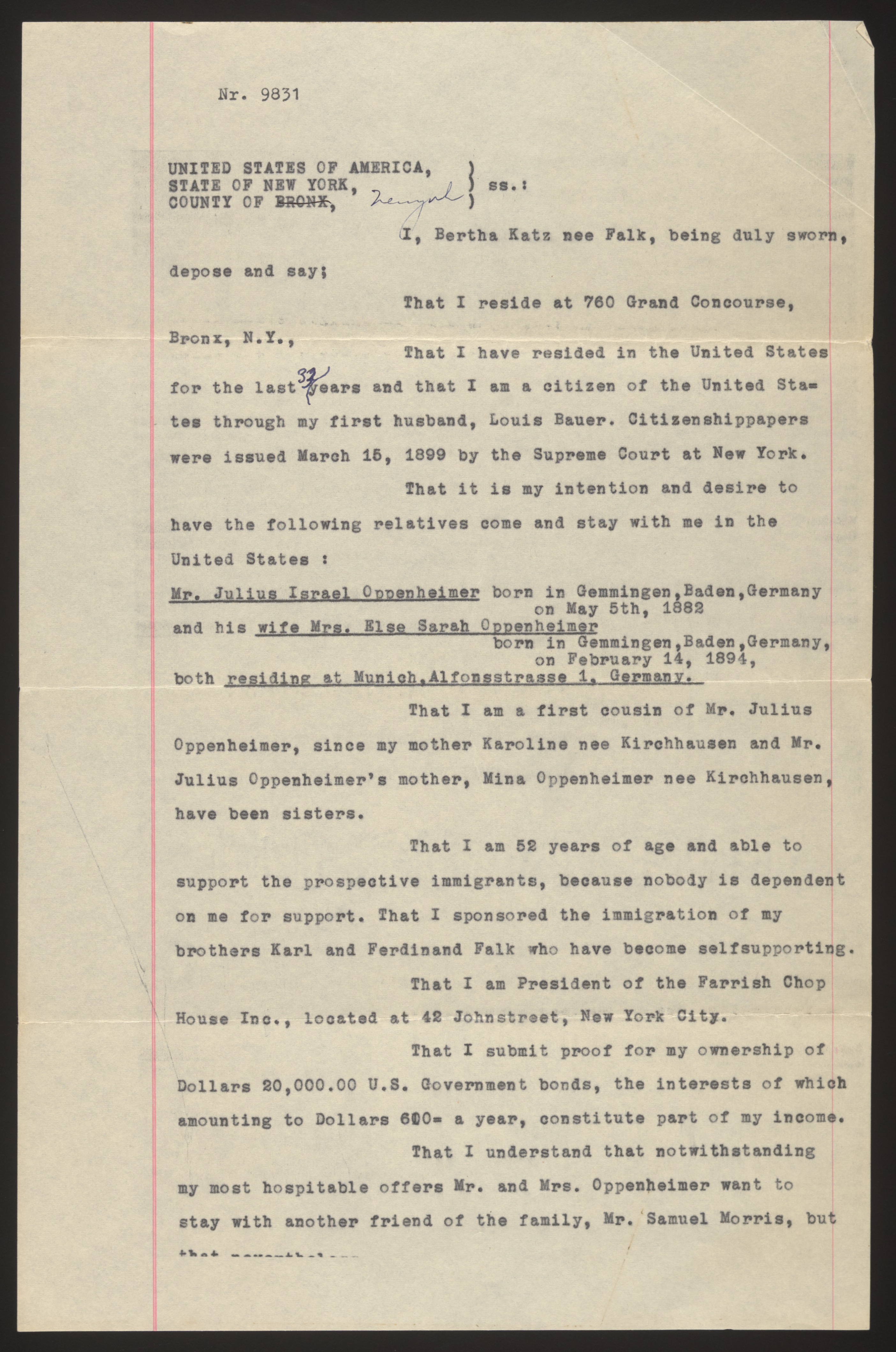
Typed formal affidavit of support from Mrs. Bertha Katz née Falk (page 1 of 2...
02.1941
Transcribed
None
Nr. 9831
UNITED STATES OF AMERICA, }
STATE OF NEW YORK, } ss.:
COUNTY OF BRONX, [handwritten: New York] }
I, Bertha Katz nee Falk, being duly sworn,
depose and say;
That I reside at 760 Grand Concourse,
Bronx, N.Y.,
That I have resided in the United States
for the last 32 years and that I am a citizen of the United Sta-
tes through my first husband, Louis Bauer. Citizenshippapers
were issued March 16, 1899 by the Supreme Court at New York.
That it is my intention and desire to
have the following relatives come and stay with me in the
United States:
Mr. Julius Israel Oppenheimer born in Gemmingen, Baden, Germany
on May 5th, 1882
and his wife Mrs. Else Sarah Oppenheimer
born in Gemmingen, Baden, Germany,
on February 14, 1891,
both residing at Munich, Alfonsstrasse 1, Germany.
That I am a first cousin of Mr. Julius
Oppenheimer, since my mother Karoline nee Kirchhausen and Mr.
Julius Oppenheimer's mother, Mina Oppenheimer nee Kirchhausen,
have been sisters.
That I am 52 years of age and able to
support the prospective immigrants, because nobody is dependent
on me for support. That I sponsored the immigration of my
brothers Karl and Ferdinand Falk who have become selfsupporting.
That I am President of the Farrish Chop
House Inc., located at 42 Johnstreet, New York City.
That I submit proof for my ownership of
Dollars 20,000.00 U.S. Government bonds, the interests of which
amounting to Dollars 600= a year, constitute part of my income.
That I understand that notwithstanding
my most hospitable offers Mr. and Mrs. Oppenheimer want to
stay with another friend of the family, Mr. Samuel Morris, but
This is the most genealogically significant document in the collection. Bertha Katz (née Falk) establishes her blood relationship to Julius Oppenheimer: her mother Karoline (née Kirchhausen) and Julius's mother Mina Oppenheimer (née Kirchhausen) were sisters — making Bertha and Julius first cousins. This confirms the Kirchhausen maiden name of Julius's mother and establishes a key maternal family connection. Bertha's own biography is remarkable: she came to America 32 years earlier (around 1909), gained citizenship through her first husband Louis Bauer in 1899, and by 1941 was President of the Farrish Chop House, Inc. at 42 John Street in lower Manhattan — a successful businesswoman owning $20,000 in U.S. Government bonds (about $430,000 today). She had previously sponsored her brothers Karl and Ferdinand Falk. Note that Elsa's birth year is given here as 1891, whereas the Langerbein affidavit (0021) gives 1894 — a discrepancy that may require further verification. The registration number 9831 matches the Stuttgart consulate's response letter (0029). The detail that the Oppenheimers preferred to stay with Samuel Morris rather than with Bertha adds a human dimension to the bureaucratic paperwork.
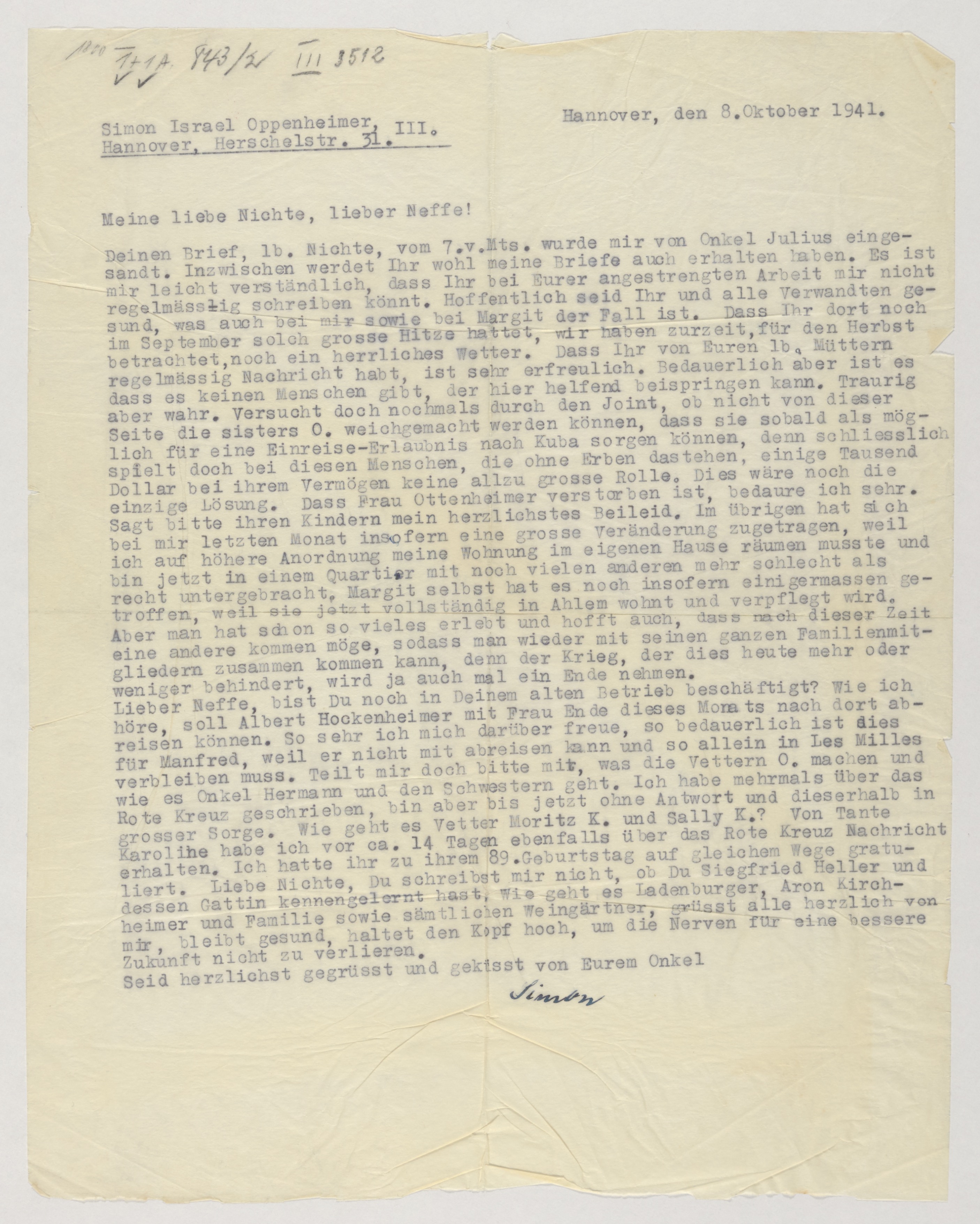
Typed letter (page 1 of 2) from Simon Israel Oppenheimer III to his niece Min...
08.10.1941
Transcribed
Simon Israel Oppenheimer III.
Hannover, Herschelstrasse 31.
Hannover, October 8, 1941.
My dear niece, dear nephew!
Your letter, dear niece, of the 7th of last month was forwarded to me by Uncle Julius. In the meantime, you will have received my letters as well. I can easily understand that with all your work you cannot always write punctually. Hopefully you and all the relatives are well, which is also mostly the case with me. For the [autumn] we do not have such great heat as you do; we still have wonderful weather for this time of the autumn. That you receive regular news from nephew D. Katten is very pleasing; in Hannover, however, it is unfortunately the case that one can [barely get field post through]. Sad, but true. Do try once more through the Joint [Distribution Committee] whether it might be possible to learn the address of O., so that as soon as possible an entry [permit] toward Cuba could be arranged for him, because after all, with these people, for whom the Dollar plays such a big role, it would mean the least [difficulty]. I am very sorry to hear that Mrs. Ottenheimer has passed away. Please give my heartfelt condolences to her children. I have in the past months still had some things to move, and under current orders I had to vacate my apartment into [another] house and am now in quarters that are something quite different from what one is accustomed to. Margit herself still has it somewhat bearable insofar as she now lives entirely in the old [place] and manages. But one has already [adjusted] to this, and one will surely see each other again, just as one will come together again with one's whole family, because the war — you must also see this — will come to an end someday.
Dear nephew, are you still employed at your old business? As I [learned] from your wedding day... [several lines difficult to decipher due to typewriter quality]... Please go to Mrs. Gundersheimer, with her I have left a box of [Glanzbilder/collectible cards] for you, with great care. How are Aunt Sophie K. and Sally K.? From Aunt Henny I also received news about 14 days ago through the Red Cross. I was very glad to receive greetings for the holidays as usual... [additional personal greetings, partially illegible]... So once again, warmest greetings from your uncle.
Be most warmly greeted and kissed by your uncle
Simon
Simon Israel Oppenheimer III.
Hannover, Herschelstr. 31.
Hannover, den 8. Oktober 1941.
Meine liebe Nichte, lieber Neffe!
Deinen Brief, lb. Nichte, vom 7. v. Mts. wurde mir von Onkel Julius eingesandt. Inzwischen werdet Ihr wohl meine Briefe auch erhalten haben, mir leicht verständlich, dass Ihr bei Eurer Vielarbeit erst nicht immer pünktlich schreiben könnt. Hoffentlich seid Ihr und alle Verwandten gesund, was auch bei mir zum grössten Teil der Fall ist. Für den [Herbst] zu haben wir nicht solch grosse Hitze wie bei Euch; wir haben zurzeit für den Herbst betrachtet noch ein herrliches Wetter. Dass Ihr vom Neffen D. Katten regelmässig Nachricht habt, ist sehr erfreulich, in Hannover aber ist es leider so, dass man hier Feldpost beigrimmmen kann. Traurig, aber wahr. Versucht doch nochmals durch den Joint, ob nicht von dort die Adresse O. er etwas erfahren werden könnte, dass er sobald als möglich, um ihn eine Einreise-[Erlaubnis] Richtung nach Kuba sorgen können, denn schliesslich spielt doch bei diesem Menschen, die das Wort [?] Dollar bei denen keine solche, alldem grosse Rolle. Dies wäre noch die wenigsten [?]. Dass Frau Ottenheimer verstorben ist, bedauere ich sehr. Sagt bitte Ihren Kindern mein herzliches Beileid. Ich habe bis jetzt in den letzten Monats immer noch etwas Verkleidung nachtragen, und bei jetziger Anordnung meine Wohnung in eigenes Haus räumen müssen und bin jetzt in einem Quartier das doch etwas anderes ist [als] man gewöhnt ist. Margit selbst hat es noch insofern einigermassen [erträglich], weil sie jetzt Vollständig in Altem wohnt und sorgen [?]. Aber man hat sich da schon zu [?], oder man [?] und dort und man sieht sicher wieder, ebenso man wieder mit seinen ganzen Familiengliedern zusammen kommen kann, denn der Krieg, das müsst Ihr ja auch wohl einsehen, wird ja auch mal ein Ende nehmen.
Lieber Neffe, bist Du noch in Deinem alten Betrieb beschäftigt? Wie ich damals von Eurem Hochzeitstag mir Eurer Freund[?]. Be danach auch nach langem der Partner frei ist, würde es mich sehr freuen. Du wirst ich das Er darber freut kann und so allein in diesem Milieu verbleiben [?]. Wenn auch die bitte bitte Dir und Deine Mutter in Eurem Haus. Leb wohl jetzt mein Lieber u. lass Mich bitte baldmöglichst über Dich hören. Geh zu Frau Gundersheimer, bei dieser habe ich Dir eine Schachtel von Glanzbilder in Grosser Sorge. Wie geht es Tante Sophie K. und Sally K.? Von Tante Henny Mues ich Dir von ca. 14 Tagen ebenfalls über das Rote Kreuz Nachricht erhalten. Ich habe für zu Grosser Freude auf die Feiertage und wie übliche [?] Grüsse. Auch Nichte, ich schreibe Dir nicht, ob Siegfried Heller und dessen Gattin [?] reguliert habt wie geht es Leutrungen. Anna Kloten von Heimer und Familie Erwin [?] es ihnen. Also nochmals alle herzlichen Grüsse von Euren Onkel.
Seid herzlichst gegrüsst und geküsst von Eurem Onkel
Simon
This letter, dated October 8, 1941, was written just weeks before the first mass deportation of Jews from Hannover (on December 15, 1941, to Riga). Simon's mention of being forced to vacate his apartment reflects the Nazi policy of "Zusammenlegung" — the compulsory relocation of Jews into designated "Judenhäuser" (Jewish houses), which concentrated Jewish residents into overcrowded shared quarters as a prelude to deportation. His use of the mandatory middle name "Israel" (required since 1939) is visible in the letterhead. Communication was increasingly restricted — Simon notes receiving news only through the Red Cross. His attempts to arrange emigration to Cuba through the Joint Distribution Committee reflect the desperate search for any escape route. The letter reveals a man trying to maintain family connections and a sense of normalcy while living under increasingly dire conditions. Simon Israel Oppenheimer III was deported from Hannover and murdered in the Holocaust.
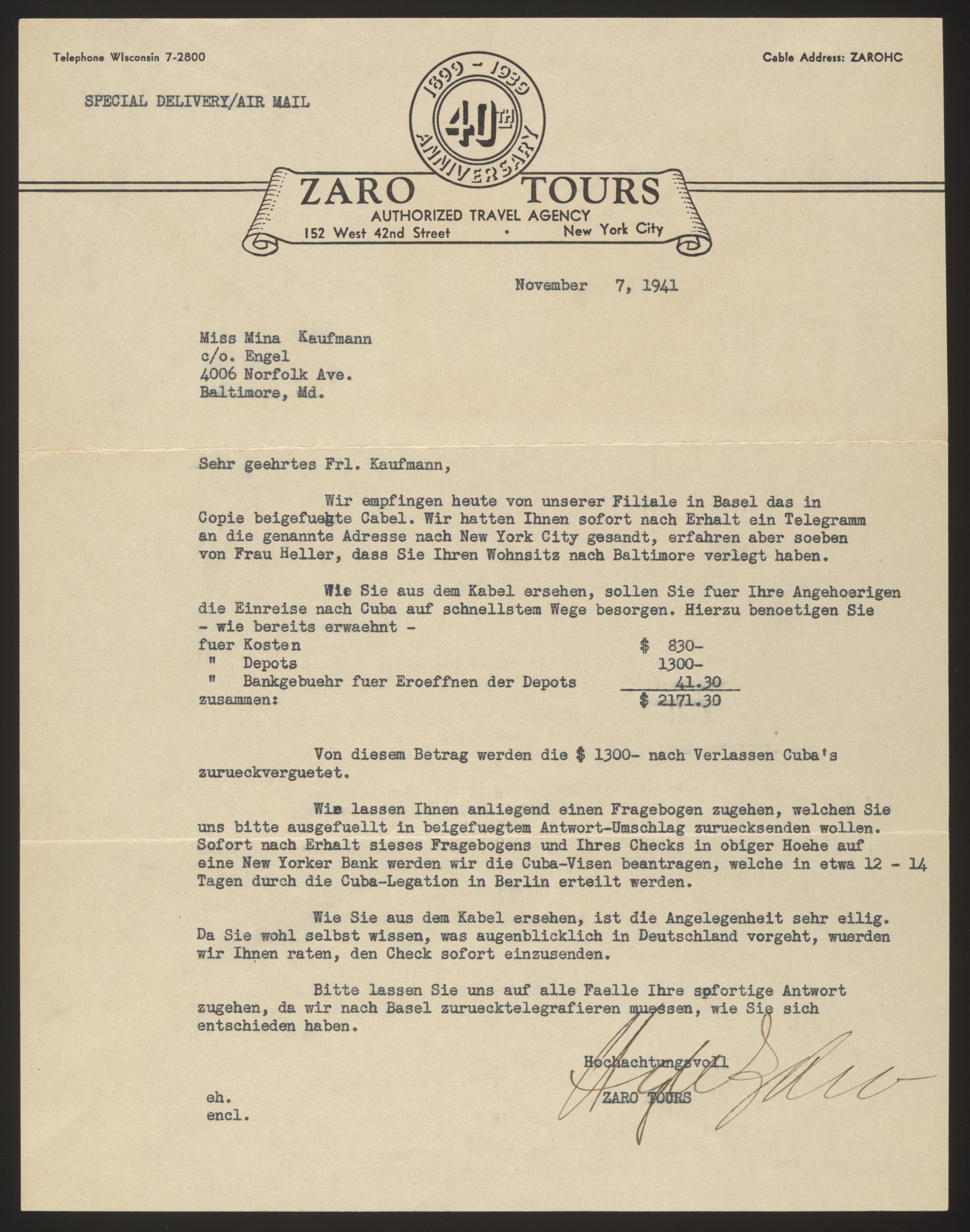
Typed letter from Zaro Tours to Mina Kaufmann, in German, regarding Cuba visa...
07.11.1941
Transcribed
Telephone Wisconsin 7-2800 Cable Address: ZAROHC
SPECIAL DELIVERY / AIR MAIL
ZARO TOURS
AUTHORIZED TRAVEL AGENCY
152 West 42nd Street • New York City
November 7, 1941
Miss Mina Kaufmann
c/o Engel
4006 Norfolk Ave.
Baltimore, Md.
Dear Miss Kaufmann,
Today we received from our Basel branch the cable enclosed in copy. Immediately
upon receipt we sent a telegram to the address given in New York City, but have just
learned from Mrs. Heller that you have moved your residence to Baltimore.
As you can see from the cable, you are to arrange entry to Cuba for your relatives
by the quickest route. For this you will need — as already mentioned —
for costs $ 830—
" deposits 1300—
" bank fee for opening the deposits 41.30
total: $ 2,171.30
Of this amount, the $1,300 will be refunded after leaving Cuba.
We are enclosing a questionnaire, which we ask you to fill out and return to us
in the enclosed reply envelope. Immediately upon receipt of this questionnaire and your
check in the above amount drawn on a New York bank, we will apply for the Cuba visas,
which will be issued in approximately 12–14 days through the Cuban Legation in Berlin.
As you can see from the cable, the matter is very urgent. Since you yourself
know what is currently happening in Germany, we would advise you to send the check
immediately.
Please send us your immediate reply in any case, as we must cable back to Basel
regarding your decision.
Respectfully,
ZARO TOURS
[Signature]
encl.
Telephone Wisconsin 7-2800 Cable Address: ZAROHC
SPECIAL DELIVERY / AIR MAIL
[40th Anniversary logo: 1899-1939]
ZARO TOURS
AUTHORIZED TRAVEL AGENCY
152 West 42nd Street • New York City
November 7, 1941
Miss Mina Kaufmann
c/o. Engel
4006 Norfolk Ave.
Baltimore, Md.
Sehr geehrtes Frl. Kaufmann,
Wir empfingen heute von unserer Filiale in Basel das in
Copie beigefuegte Cabel. Wir hatten Ihnen sofort nach Erhalt ein Telegramm
an die genannte Adresse nach New York City gesandt, erfahren aber soeben
von Frau Heller, dass Sie Ihren Wohnsitz nach Baltimore verlegt haben.
Wie Sie aus dem Kabel ersehen, sollen Sie fuer Ihre Angehoerigen
die Einreise nach Cuba auf schnellstem Wege besorgen. Hierzu benoetigen Sie
— wie bereits erwaehnt —
fuer Kosten $ 830—
" Depots 1300—
" Bankgebuehr fuer Eroeffnen der Depots 41.30
zusammen: $ 2171.30
Von diesem Betrag werden die $1300— nach Verlassen Cuba's
zurueckverguetet.
Wir lassen Ihnen anliegend einen Fragebogen zugehen, welchen Sie
uns bitte ausgefuellt in beigefuegtem Antwort-Umschlag zuruecksenden wollen.
Sofort nach Erhalt dieses Fragebogens und Ihres Checks in obiger Hoehe auf
eine New Yorker Bank werden wir die Cuba-Visen beantragen, welche in etwa 12 — 14
Tagen durch die Cuba-Legation in Berlin erteilt werden.
Wie Sie aus dem Kabel ersehen, ist die Angelegenheit sehr eilig.
Da Sie wohl selbst wissen, was augenblicklich in Deutschland vorgeht, wuerden
wir Ihnen raten, den Check sofort einzusenden.
Bitte lassen Sie uns auf alle Faelle Ihre sofortige Antwort
zugehen, da wir nach Basel zuruecktelegrafieren muessen, wie Sie sich
entschieden haben.
Hochachtungsvoll
eh. ZARO TOURS
encl. [Signature]
This letter represents the final, desperate attempt to rescue Julius and Elsa Oppenheimer. Zaro Tours — a well-known New York travel agency that specialized in helping refugees (founded 1899, celebrating its 40th anniversary on the letterhead) — relayed the urgent cable from their Basel, Switzerland branch. The plan was to obtain Cuban entry visas through the Cuban Legation in Berlin within 12-14 days, at a total cost of $2,171.30 (approximately $46,000 today). The $1,300 deposit was refundable upon leaving Cuba — a standard requirement to guarantee that refugees would not become permanent charges on the Cuban state. The chilling line "Since you yourself know what is currently happening in Germany" alludes to the escalating persecution without explicitly naming it — by November 1941, mass deportations of German Jews to eastern ghettos and killing sites had already begun. Mina Kaufmann had moved to Baltimore (c/o Engel, 4006 Norfolk Avenue), and the scramble to reach her — first a telegram to New York, then learning from Mrs. Heller about the move, then Special Delivery to Baltimore — underscores the frantic pace. The Cuba route via the Cuban Legation in Berlin was one of the last remaining escape paths, but it required an agonizing sequence: payment from New York to Zaro Tours, application through Berlin, visa issuance, and then actual departure from Germany — all within a rapidly closing window. The United States would enter the war exactly one month later.
Notes
Simon's Oct 1941 letter: 'Please go to Mrs. Gundersheimer, with her I have left a box of collectible cards for you, with great care.'